







By Francesco Canepa and Balazs Koranyi
FRANKFURT, Dec 18 (Reuters) – The European Central Bank kept its policy rates steady on Thursday and revised upwards some of its growth and inflation projections, a move that probably closes the door to further rate cuts in the near term.
Recent growth figures for the euro zone have beaten the ECB’s expectations, buoyed by exporters navigating U.S. tariffs more effectively than anticipated and by domestic spending that has counterbalanced a malaise in manufacturing.
Inflation has meanwhile hovered around the ECB’s 2% target, boosted by price hikes in the services sector, and is expected to stay there for the foreseeable future.
The more upbeat outlook has already led investors to draw a line under an easing cycle that saw the ECB halve its policy rate from 4% to 2% in the year to last June.
Other central banks are also seen nearing a halt to rate cuts. The U.S. Federal Reserve last week signalled one more move in 2026 and the Bank of England noted after its rate cut on Thursday that the future pace at which borrowing costs are lowered might slow.
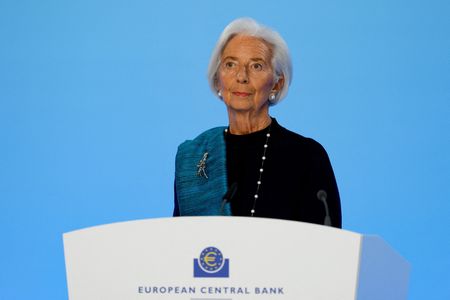
Asked at a press conference whether the ECB’s next rate move was more likely to be up than down, the bank’s President Christine Lagarde said policymakers agreed there was “no set date for any move”.
“It was a unanimous view around the table,” she said, repeating the ECB line that it would set borrowing costs meeting-by-meeting depending on incoming data and that it was not pre-committing to a particular rate path.
“With the degree of uncertainty we are facing, we simply cannot offer forward guidance,” she added.
In its statement, the ECB said the uncertain global outlook would remain a drag on growth in the 20-country euro zone and renewed its appeal for national governments to push ahead with reforms to make the economy more efficient and competitive.
RATE HIKE NEXT?
In its new projections, the ECB still sees inflation dipping below 2% next year and in 2027, mostly on lower energy costs, but then expects it to come back to the target in 2028. It signalled that services inflation might decline more slowly than expected due to wage costs.
Output growth was seen as slightly quicker this year because the euro zone economy is proving more resilient than feared to the impact of higher U.S. tariffs and cheap Chinese imports. Lagarde said exports meanwhile remained “sustainable” in the current climate.
The ECB now expects growth of 1.4% this year, 1.2% in 2026, and 1.4% in 2027 and 2028.
Private-sector economists, too, expect growth to carry forward into next year, supported by the German government’s planned investments in defence and infrastructure and a relatively tight labour market, where workers have finally seen wages catch up with the post-pandemic surge in prices.
Some recent comments from ECB board member Isabel Schnabel, chief economist Philip Lane and Lagarde herself have helped fuel some speculation about a rate hike late next year.
Financial markets have begun pricing modest chances of a rate hike late next year or early in 2027 [GVD/EUR].
But most economists polled by Reuters expect the ECB to leave rates where they are through 2026 and 2027, although the forecast range for the latter year was wide at 1.5%-2.5%.
“The reality is, the bar is probably quite high for a move in either direction in the next few meetings,” BNP Paribas chief economist Isabelle Mateos y Lago said.
The ECB’s core inflation forecasts for 2026-27 were nudged higher too.
These are crucial as they factor out the effect of a delay to the European Union’s new carbon trading scheme, which will mechanistically bring down headline inflation in 2026-27 and push it up in 2028.
Among factors likely to weigh on inflation is the euro’s strength against the Chinese yuan or renminbi, which is making it even harder for the euro zone to compete with China, and against the U.S. dollar, which may fall further if the Federal Reserve cuts rates more rapidly under a new chair.
(Reporting by Francesco Canepa; Editing by Catherine Evans and Mark John)
Brought to you by www.srnnews.com