





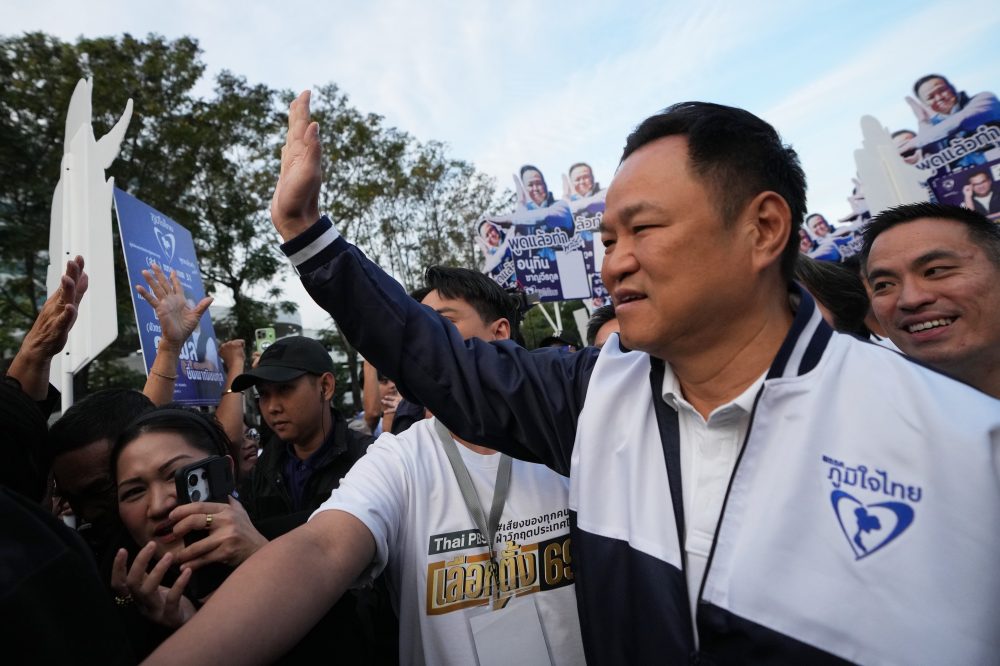
BANGKOK (AP) – Political parties in Thailand on Sunday registered their candidates for the next prime minister, marking the unofficial start of campaigning for the Feb. 8 general election.
Prime Minister Anutin Charnvirakul dissolved Parliament earlier this month to call early polls, after the main opposition party prepared to seek a no-confidence vote over constitutional change. Calling a new election allows Anutin and his Bhumjaithai Party to build up their numbers in the House of Representatives to gain a more secure grip on government.
Voters will simultaneously cast ballots in a referendum asking whether they want a new constitution, a move promoted by progressive parties who claim the current powers held by the bureaucracy and unelected bodies are undemocratic.
The election is seen as primarily pitting Anutin’s conservative party against the progressive People’s Party, which under a different name and leadership won the highest number of House seats in the 2023 election. It ended up being blocked by conservative lawmakers from gathering enough support to form a government.
The populist Pheu Thai Party, backed by billionaire former Prime Minister Thaksin Shinawatra, is another major contender. It took power after the 2023 election, when the People’s Party’s effort was stymied. Thaksin remains the dominant figure behind Pheu Thai even though he is serving a prison term for convictions related to corruption and abuse of power.
Anutin has held office for only three months after the court-ordered removal of his predecessor, Thaksin’s daughter Paetongtarn Shinawatra, for what were judged ethical lapses.
Anutin’s government saw a slip in popularity following deadly flooding in southern Thailand and high-profile scandals that ensnared several officials and business figures. However, he may have boosted his appeal by adopting an aggressive military posture appealing to nationalists as Thailand engaged in large-scale combat with Cambodia over a long-standing border dispute.
The Election Commission says 68 people from 32 parties registered as prime minister candidates, while 1,502 people from 52 parties are running as “party list” nominees, who gain seats according to each party’s proportional share of the vote. Another 3,092 candidates are running for direct election by constituency.
Each party is allowed to propose up to three candidates. The Bhumjaithai party selected just two, with veteran diplomat Sihasak Phuangketkeow, who currently serves as foreign minister, being the backup to Anutin. Their main challenger is the People’s Party.
Anutin won the September vote to become prime minister with support from the People’s Party in exchange for a promise to dissolve Parliament within four months and organize a referendum on the drafting of a new constitution by an elected constituent assembly. However, the People’s Party at the same time insisted on acting as an opposition party.
Its position now is that Anutin and his party showed bad faith in a vote on constitutional change, and dissolving Parliament constituted a final break of their temporary partnership.
People’s Party leader Natthaphong Ruengpanyawut, its primary candidate for prime minister, vowed that none of its lawmakers will support Anutin or Sihasak for prime minister.
The People’s Party continues to push a reformist agenda, including a controversial pledge to seek amnesty for political prisoners, specifically those held under Thailand’s strict law curbing criticism of the monarchy. Its position puts it sharply at odds with Thailand’s powerful royalist conservative establishment.
The Pheu Thai party, the current incarnation of Thaksin’s political machine, is fielding 46-year-old Yodchanan Wongsawat as its main candidate for prime minister.
Brought to you by www.srnnews.com