





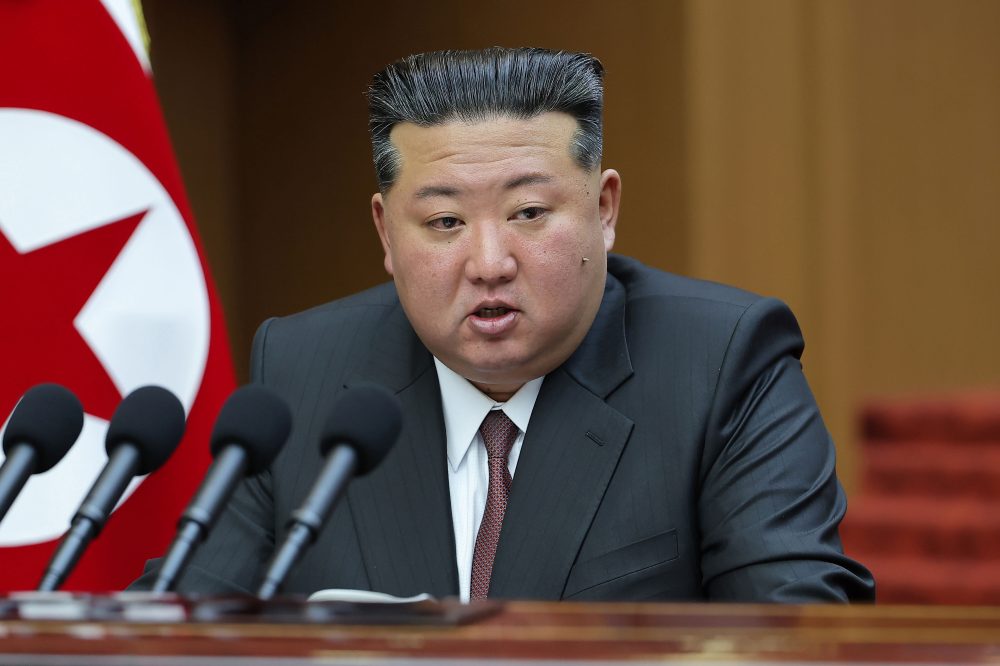
SEOUL, South Korea (AP) – North Korea on Thursday unveiled a new facility to produce nuclear bomb fuels, with leader Kim Jong Un announcing plans to bolster the country’s nuclear forces “at an exponential rate.”
South Korea’s Joint Chiefs of Staff assessed the site as a uranium enrichment plant and said it was closely coordinating with the United States to monitor North Korean nuclear activities. The South’s military did not immediately release further details.
The North’s official Korean Central News Agency said the facility used “more sophisticated technology” but didn’t provide further details. It’s not clear where the plant is or when it began operations. State media photos showed what appeared to be a large hall housing centrifuges, which are needed to enrich weapons-grade uranium.
The disclosure of the new factory is in line with Kim’s repeated vows to expand his nuclear weapons program to cope with what he called escalating U.S.-led military threats.
KCNA said Kim visited the nuclear facility on Wednesday to learn about its operations and its long-term production plan.
KCNA quoted Kim as saying the urgency for bolstering up the country’s nuclear war deterrent, both in quality and quantity, has grown because of confrontations with “the most ferocious enemies,” an apparent reference to the United States and South Korea. Kim cited other unspecified threats and crises as a need to boost North Korea’s nuclear capability, it said.
Kim claimed that North Korea’s weapons-grade nuclear materials production capacity has more than doubled compared with five years ago, according to KCNA. It wasn’t possible to independently verify his claim.
After a meeting at the facility, Kim said that he and other top officials “confirmed the order of priority for implementing the ambitious future plan designed to beef up our state’s nuclear forces at an exponential rate,” KCNA said.
KCNA photos showed Kim walking through narrow aisles lined with dense rows of silver tubes and pipes, in what appeared to be a centrifuge hall. Another image showed him speaking with senior officials in a meeting room, where a blurred graphic depicting a cone-shaped object was spread across a table. It wasn’t immediately clear whether the graphic showed a warhead design.
The facility’s revelation came less than two years after North Korea unveiled another covert uranium-enrichment plant in September 2024, in its first public disclosure of such a facility since showing one at the country’s main Yongbyon nuclear complex to visiting American scholars in 2010.
Kim delivered a similar message during his visit to that facility in 2024, calling for an increase in the number of centrifuges to “exponentially” expand the country’s nuclear arsenal and urging the development of more advanced centrifuge systems.
North Korea has not conducted a nuclear test since 2017, but in recent years it has expanded its arsenal of nuclear-capable missiles that can fly far enough to reach both U.S. allies in Asia and the American mainland, while Kim has also pushed to increase the country’s stockpile of nuclear weapons.
A senior South Korean official told lawmakers in 2018 that North Korea was estimated to have manufactured between 20 and 60 nuclear weapons, but some experts now put the size of the North’s arsenal at more than 100 warheads. Estimates of how many additional weapons the country can produce each year vary from about six to as many as 18.
Last September, South Korean Unification Minister Chung Dong-young said that North Korea was operating a total of four uranium enrichment facilities including the Yongbyon complex, and that they were running everyday.
Nuclear weapons can be built using either highly enriched uranium or plutonium, and North Korea has facilities to produce both at Yongbyon.
North Korea has focused on enlarging and modernizing its nuclear arsenal since Kim’s high-stakes diplomacy with U.S. President Donald Trump collapsed in 2019. Kim has since rebuffed U.S. and South Korean offers to restart diplomacy.
In April, International Atomic Energy Agency Director General Rafael Grossi told reporters that his agency had confirmed “a rapid increase” in activities at nuclear facilities in North Korea.
Brought to you by www.srnnews.com