





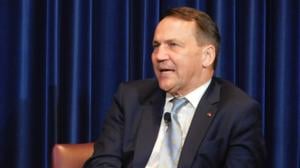
(The Center Square) – As a child going to bed, Radoslaw Sikorski heard the sound of a free press through the thin wall of his family’s home in Soviet-ruled Poland.
On the other side was his father in another room, listening to Radio Free Europe broadcasts, which, unlike Soviet-run media, was uncensored.
“We literally learned from Radio Free Europe what was happening in our own country, our own city,” said Sikorski, who grew up to value freedom and become deputy prime minister today of a democratic Poland.
Sikorski, who’s also the minister of foreign affairs, talked about President Ronald Reagan’s role in Poland’s transition to democracy and Ukraine’s defense against Russia Tuesday evening at the Ronald Reagan Presidential Library and Museum.
The Radio Free Europe broadcasts inspired Poland, a NATO member, to today expand its foreign broadcasting to former Soviet countries, Sikorski told several hundred people in the packed auditorium in Simi Valley, just north of Los Angeles.
Sikorski answered questions on stage from Melissa Giller, chief marketing and cultural programming director for the Ronald Reagan Presidential Foundation and Institute. Giller asked what kept him up at night.
“The number of nuclear states is increasing,” Sikorski said. “What worries me is the inequalities between countries and within countries are becoming so huge that it may produce a revolutionary situation. I think Ronald Reagan, as a good conservative, would have seen this danger and would have wanted to preempt this through the political process to prevent a disaster.”
Sikorski praised Reagan’s role in ending Soviet rule of Eastern Europe.
“He’s remembered as someone who understood the nature of communism, who called it by name and who gave hope to those living behind the Iron Curtain,” Sikorski said.
“What gives me optimism is it is innate in our nature to have some influence over one’s life and the lives of one’s children because it’s more secure than handing over one’s life to a dictator,” the Polish deputy prime minister said. “People do want to control and therefore want check and balances on authority and some form of representation.”
While free from the former Warsaw Pact bloc of the former Soviet Union, Poland continues to face aggression from Russia, Sikorski said.
“If it was only cyber attacks, we wouldn’t be so worried because they do it every day,” Sikorski said, but noted Russia has waged other forms of aggression against Poland and elsewhere in Europe for 10 years such as supporting radical political parties and sponsoring terrorism, including bombings.
“Until the invasion of Ukraine, we – or rather you in Western Europe and the U.S. – didn’t acknowledge it. You thought it was a nuisance. ‘He (Russian President Vladimir Putin) can’t be serious.’ And many people did not believe he would actually invade,” Sikorski said.
“As long as Ukraine is fighting them so successfully, they don’t have the forces to invade a western country. We would see any concentrations of troops,” Sikorski said, emphasizing the importance of Ukraine’s resistance.
“They are not only defending themselves,” Sikorski said. “If Putin succeeded in conquering Ukraine, all of Europe would be in trouble.”
Ukraine hosted a high-level visitor last week when U.S. Sen. Lindsey Graham, R-South Carolina, visited the nation one day before his sudden death Saturday from what is believed likely to be aortic dissection.
Sikorski said he knew Graham and praised him for his support of more aid for Ukraine. Graham has been among senators advocating for more military assistance to Ukraine, and in April 2025, Graham introduced the Sanctioning Russia Act. The legislation has support in both houses of Congress, and some members have suggested it be renamed after Graham.
“I hope his memory is honored and the bill is passed,” Sikorski said.