







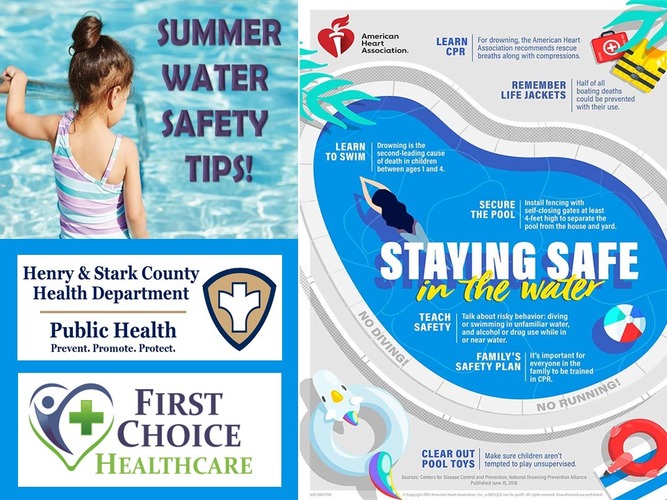
The Henry and Stark County Health Departments are urging families to remain vigilant about water safety, as drowning remains the fifth leading cause of unintentional injury and death, according to the Home Safety Council. Any source of standing water—such as pools, buckets, or bathtubs—can pose a risk. Officials stress the importance of constant adult supervision, installing proper pool fencing with self-closing gates, and removing clutter from pool areas. Swimming lessons for children over five are highly recommended, while learning CPR is vital for caregivers. Emergency numbers should be posted near pool areas. For more details, connect with the Health Department on social media.
“Drowning is a sudden and silent danger,” notes the Home Safety Council. “Since drowning victims do not make any noise once in distress, constant supervision around any body of water is critical and the best method of prevention.”
The Health Department urges families to take the following basic safety precautions around water outdoors and in-home.
- Always practice constant adult supervision around any body of water.
- Older children should not be left in charge of younger children in the pool area.
- Install four-sided fencing that isolates the pool from the home.
- Four-sided pool fencing is proven to be an effective drowning prevention intervention. While many communities have codes or regulations that require some form of pool fencing, there is no consistent national standard.
- Pool fencing should be a least five feet high and have self-locking and self-closing gates.
- Position the gate latches out of the reach of young children.
- Never prop the gate open or disable the latch.
- Clear debris, clutter, and pool toys from the pool deck and adjoining pathways to prevent falls.
- Keep a cordless, water-resistant telephone in the pool area and post emergency numbers near the pool area.
- Enroll non-swimmers in swimming lessons taught by a qualified instructor. Pediatricians recommend that children ages 5 and older learn how to swim.
- Never swim alone. Even adults should always swim with a buddy.
- Learn and practice the basic lifesaving techniques, including first aid and CPR. Insist that anyone who cares for your children learn CPR.
- Keep poolside rescue equipment close to the pool area.
- Post emergency numbers and CPR instructions prominently near the pool area.