





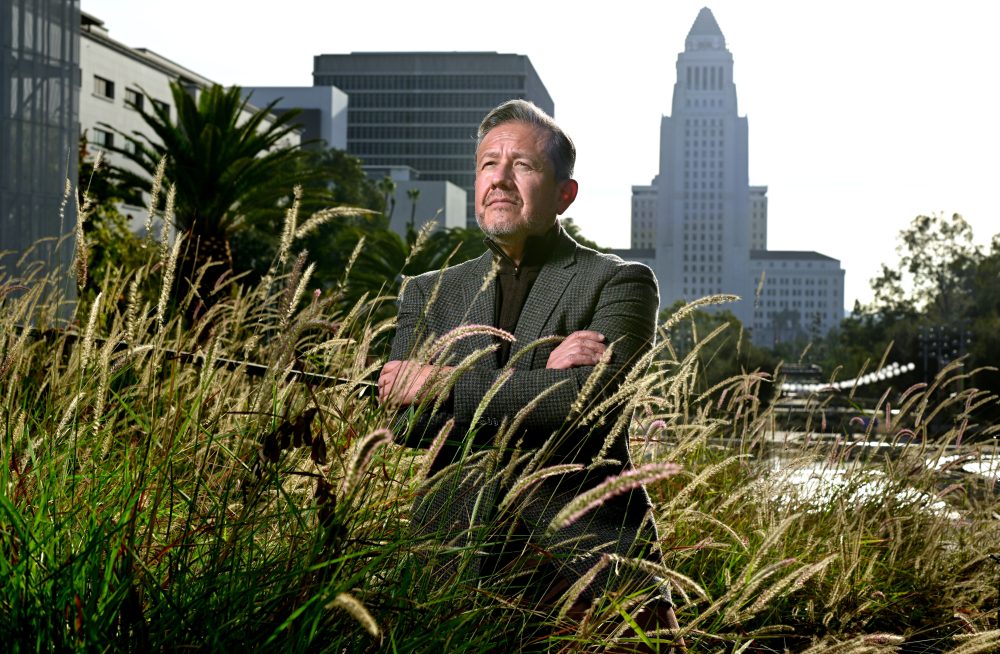
When fires broke out across Los Angeles on Jan. 7, 2025, Miguel Santana grasped the magnitude of the catastrophe befalling his hometown sooner than most – he flew over the blazes, twice.
Climbing above the LA basin on his way to a meeting in Sacramento, the California Community Foundation CEO watched flames engulf homes and hillsides in the Pacific Palisades as fierce winds shook the airplane cabin. Before he returned the next day, another fire began tearing through Altadena, 30 miles northeast of the Palisades.
“Flying over it really brought light to how serious the whole thing was,” said Santana, a longtime civil servant for LA city and county before entering philanthropy. “From the very beginning I had a feeling this was going to be a really unprecedented disaster.”
CCF immediately activated its wildfire recovery fund, donating $30 million in the first month to nonprofits helping survivors with immediate needs.
One year later, the fund has raised over $100 million from nearly 50,000 donors worldwide, offering a singular opportunity to help survivors and a daunting challenge of where to focus resources over a years-long recovery.
The Palisades and Eaton fires killed 31 people and destroyed 17,000 structures, impacting tens of thousands of Angelenos who lost homes, schools, places of worship, and jobs. An estimated 7 in 10 survivors are still not home and only 10 houses are rebuilt across both fire footprints. Mental health among survivors is worsening as they struggle to regain stability.
Santana spoke with The Associated Press in December about the future of LA’s recovery. The interview was edited for clarity and length.
We were trying to support those communities and survivors who were most likely going to fall through the cracks. Senior citizens, children, renters, folks who lost employment and were living paycheck to paycheck.
I also felt it was important that we start identifying what were the systemic issues that were going to surface, and start supporting advocacy around that.
We know that during a disaster, whether it’s COVID or any other, the inequities that existed prior only get amplified. So we were concerned that it was going to be an uneven recovery.
I reached out to a friend and someone I worked with closely during the pandemic, a fellow Angeleno, Evan Spiegel, the co-founder and CEO of Snap. He grew up in the Palisades, so this is his community.
Within days of the fires being finally taken out, we convened survivors from around the country to share their stories with LA survivors. They grieved together and shared what they were going through.
From that meeting emerged the (fire recovery nonprofit) Department of Angels, which has been tracking the survivor experience and trying to center it in every step of the recovery process. We identify what are the barriers being confronted, and try to support those who are advocating on the ground.
We do quarterly surveys of over 2,000 survivors. I could tell you right now based on those surveys what the state of the recovery has been like and what are the real challenges people are confronting.
Right now, insurance. Which carrier (you have) is the primary determinant of how well your recovery is going.
Survivors are feeling stuck, and they’re starting to run out of options. If you did receive some proceeds from insurance to take care of living expenses, those are going to run out shortly. They’re still paying mortgage on their (burned) property, insurance, property tax, yet they’re renting somewhere else.
Their ability to access capital is limited to their current financial situation, but the need they have is much greater than that financial situation.
We’re working with financial institutions like Bank of America and others to come up with a new product so that survivors have a way to access capital, basically providing a silent second type of financing where philanthropy is the guarantor so a family is able to access traditional lending.
This is where philanthropy can play a unique role to not lend the money, but rather provide the backstop support so that traditional lenders can lend. We hope to announce it early in the first quarter of the year.
Philanthropy raised $1 billion, but $1 billion is not enough. Philanthropy has a specific purpose, to fill in gaps, to act quickly, to identify systemic issues. But the role of philanthropy is not to provide the kind of support needed on an ongoing basis at the scale needed.
Angelenos should be able to rely on support from the federal government in the same way other survivors get it. There should be a common expectation that when there’s a crisis in our backyard, the rest of the country is going to come to our support.
I think there’s a consensus among Americans that that’s the role of the federal government, and we haven’t given up on that idea.
Not only do we need to fight for a quick and equitable recovery, but we need take care of one another.
If you know someone who’s been impacted, this is the time to reach out to them. To check in on how they’re doing, to invite them over for dinner, to look after their kids so they can have a moment.
As close as we’ve been as Angelenos, and it’s really quite remarkable how the community has come together, people are still feeling alone and like they’re going through this one day at a time.
So this is a time to double down in supporting survivors that you may know not just of this disaster, but of any disaster around the country.
—
Associated Press coverage of philanthropy and nonprofits receives support through the AP’s collaboration with The Conversation US, with funding from Lilly Endowment Inc. The AP is solely responsible for this content. For all of AP’s philanthropy coverage, visit https://apnews.com/hub/philanthropy.
Brought to you by www.srnnews.com