





By Dan Catchpole and David Shepardson
LONDON, July 19 (Reuters) – The head of Boeing’s commercial airplane unit said on Sunday that the company is focused on increasing and improving aircraft production, “not order announcement.”
“Backlog is incredibly strong. Demand is not our issue. If we announce some orders along the way, we’ll celebrate with our customers based on if they want to do that,” Boeing Commercial Airplanes CEO Stephanie Pope told reporters at a roundtable ahead of the Farnborough Airshow.
Instead, she said the planemaker’s priority “is to listen” to customers and suppliers at the biennial international event that brings together executives from many of the industry’s largest companies.
“We’re going to understand what their challenges are, and then we’re going to update them on our products,” she said.
INCREASING JETLINER PRODUCTION
Increasing production is critical to the company’s continued financial recovery and ability to compete with European rival Airbus, whose A320 family has outsold Boeing’s 737 MAX in the lucrative narrowbody market.
The 737 makes up the majority of Boeing Commercial Airplanes’ revenue. Increasing output is necessary to pay down the company’s $26 billion net debt.
Increasing 737 and Boeing’s widebody 787 production rates “is very, very important in our recovery,” Pope said.
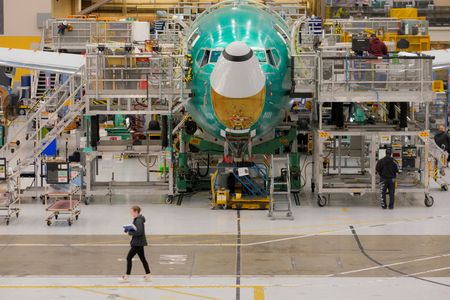
The planemaker is studying a new round of production increases for its best-selling 737 MAX after it got regulator approval in May to raise production to 47 a month.
The Federal Aviation Administration imposed an unprecedented production cap on the U.S. company shortly after a 2024 mid-air emergency that revealed widespread production safety and quality lapses at Boeing.
“We’re using the safety management system and our safety risk assessment on when we’re stable and ready to go to the next rate,” she said.
“I’ve got the team focused on stabilising at 47. Once we get to 47, we’ll go to 52, and then we’ll just keep studying” further rate increases.
DEVELOPING THE 737’S SUCCESSOR
Boeing needs to execute on production now to position itself to compete with Airbus when they both develop new narrowbody aircraft, which are not expected before 2030.
Paying down debt and funding research and development costs for a new airplane mean investors will likely have to wait for several years to see significant returns from Boeing. Investors understand that and likely will be patient, said Tony Bancroft, an analyst with Gabelli Funds investment group.
“I don’t think you need instant gratification of high amounts of growth and profitability and big, big upswings,” he said.
In addition to Boeing’s financial position, the airline market has to be ready to adopt a new airplane and the technology has to exist to deliver yield-adequate efficiency improvements, Pope said.
“We’re working on all three of those,” she said.
Currently, many Boeing engineers are working on certifying the smallest and largest 737 variants – the MAX 7 and 9 – and its new widebody 777-9.
“The importance of getting our airplanes certified is not only meeting our commitments to our customers, but that is a lot of engineering expertise and capability that we can start to roll off” and use for developing Boeing’s first clean-sheet jetliner in nearly two decades, she said.
“So, while we’ve been working on some technology, you’ll start to see that ramp up as we complete that certification work, and we take those resources and move them over,” she said.
(Reporting by Dan Catchpole and David Shepardson in London; Editing by Sharon Singleton)
Brought to you by www.srnnews.com