





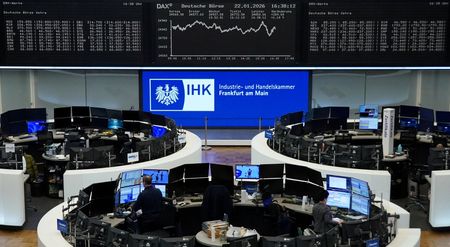
A look at the day ahead in European and global markets from Tom Westbrook
The Bank of Japan did just enough to keep the yen from falling in the Asia session, nudging up inflation forecasts and doing little to dissuade the market from expecting a couple of rate hikes this year, with the first as soon as April.
The dollar was also under a bit of pressure more broadly as perhaps investors anticipate the week’s Greenland drama leaves the U.S. diminished as an investment destination.
In sum, the world has a net long U.S. position to the tune of $27.6 trillion, leaving a fair bit of room for trimming.
After rescinding tariff threats, President Donald Trump said he had secured total and permanent U.S. access to Greenland in a deal with NATO, whose head said allies would have to step up their commitment to Arctic security.
European Union leaders heaved a sigh of relief and have said they want an EU-U.S. trade deal to be back on track, but warned they were ready to act if Trump was to threaten them again.
Closer to home, Trump withdrew his invitation for Canada to join his Board of Peace after Canadian Prime Minister Mark Carney decried powerful nations using economic integration as weapons and tariffs as leverage in a blockbuster speech at Davos.
Equities were up in Asia, but an after-hours dive in Intel shares pointed to brewing strains in the chip supply chain. The company said it had struggled to meet demand for its data-centre server chips and its stock dropped 13%.
Meanwhile, China lifted its official yuan guidance to the stronger side of 7-per-dollar for the first time since 2023 on Friday. Although that’s weaker than where market-derived expectations put the yuan’s value, it’s seen as a tacit approval.
Key developments that could influence markets on Friday:
– European and U.S. PMIs
– U.S. consumer sentiment
(Editing by Jamie Freed)
Brought to you by www.srnnews.com