





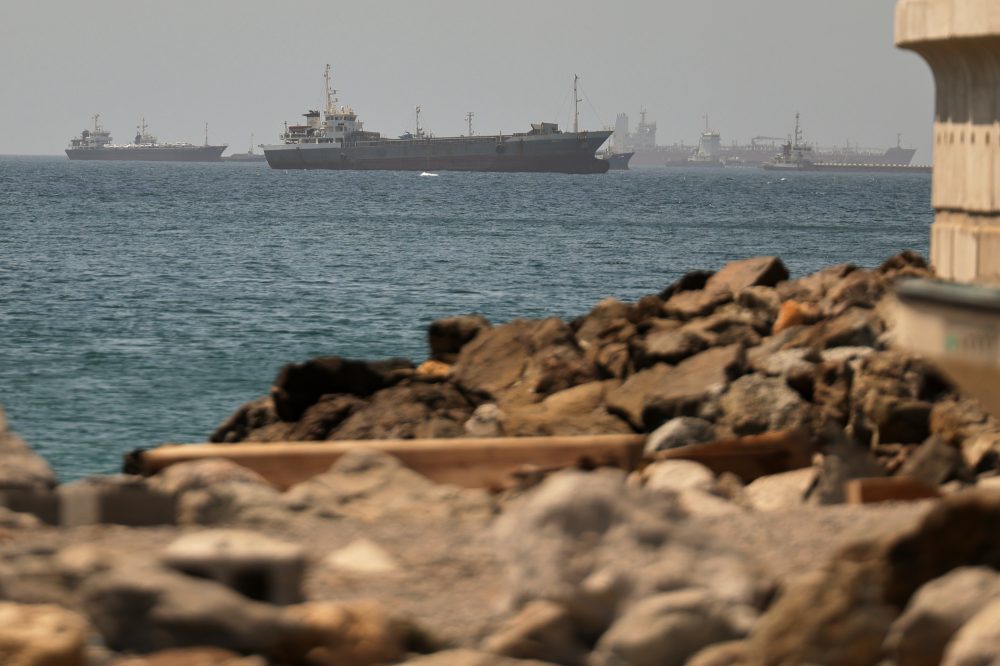
Major shipowners have begun moving vessels through the Strait of Hormuz since the U.S. and Iran signed an interim agreement to end their war, maritime data company Lloyd’s List Intelligence said Thursday.
In a media briefing, Richard Meade, editor in chief of Lloyd’s List, said for the first time in 110 days, ships owned by major companies were crossing the strait after effectively being marooned there since February.
The strait is a critical passageway for the world’s oil and natural gas. Before the war, the waterway off Iran’s coast carried a fifth of the world’s crude oil. Its closure during the war has created a historic energy crisis.
Lloyd’s List did not say how many ships were transiting through or had passed through the strait as of Thursday. It said tankers controlled by major ship owners Grimaldi Group, Cosco, Knutsen and NYK had passed through the strait. Two Iran-flagged, National Iranian Tanker Company-owned, sanctioned crude oil tankers entered the strait, according to Lloyd’s List.
Meanwhile, U.S. Vice President JD Vance said Thursday that the U.S. Navy lifted its blockade of the strait to allow some ships through Iranian ports.
Italian Foreign Minister Antonio Tajani wrote on X that an Italian merchant ship owned by the Grimaldi Group was among the first vessels to transit the strait after the agreement’s signing.
Maritime data and tracking company Kpler said it observed six verified ship crossings on Wednesday and another 11 on Thursday.
Phillip Belcher, marine director of Intertanko, a trade group for global independent tanker owners, said the main central route of the Strait of Hormuz was still closed and has an estimated 80 mines that need to be cleared. But ships have been passing through the smaller northern route, which goes through Iranian waters, and the southern route, which goes through Omani waters.
“Those two routes now seem to be fully open,” Belcher said.
However, it will take weeks or months to fully reopen the strait, and the two alternative routes don’t have as much capacity as the central passage in the Strait of Hormuz.
“This is like a highway where the road in the middle is closed and you’re using that hard shoulder,” Belcher said. “That’s now being used as the main route. We need to get back to having the highway open.”
Lloyd’s List estimated that 550 merchant ships will need to prepare to exit the Persian Gulf, including 160 tankers, 200 bulk carriers, 60 container ships and 10 vehicle carriers.
Brought to you by www.srnnews.com