





By Rajesh Kumar Singh
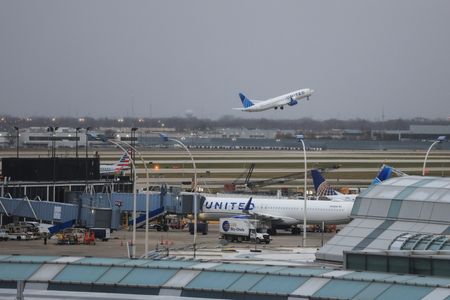
CHICAGO, Jan 16 (Reuters) – Chicago O’Hare International Airport, long a crossroads of U.S. air travel, has become the front line in an intensifying contest between United Airlines and American Airlines.
What began as a post-pandemic rebuilding of flight schedules – with United restoring capacity faster and American ramping up more recently – has evolved into a contest over gates, routes, premium offerings and market share at one of the world’s most connected airports.
Analysts say the result could have long-term implications, as better gate access and more convenient schedules can help airlines win corporate travelers, who tend to pay higher fares.
American is rebuilding at O’Hare after its post-pandemic flying remained below 2019 levels, pointing to roots in Chicago that date to its first scheduled flight in 1926. The airline calls O’Hare its third-largest hub. United, headquartered in Chicago, is focused on defending – and extending – its lead at its hometown hub.
In late December, American unveiled its largest-ever spring schedule at O’Hare, adding about 100 peak-day flights and serving more than 75 destinations. The ramp-up would lift spring operations above 500 daily flights – roughly 30% more than last year – and extend seasonal transatlantic service to Paris and Dublin.
United is pressing its advantage. This summer it plans nearly 650 daily flights to about 200 destinations from O’Hare, reflecting its larger gate footprint and wider range of connections at the airport. The carrier says it has added thousands of local employees and plans thousands more by 2027.
Those investments appear to be paying off. United said it canceled about 1% of its scheduled flights at O’Hare last year, the lowest rate in its history at the airport. The airline also said it holds nearly a 20 percentage-point lead in local passenger share over American, a gap it attributed to sustained investment, faster growth and more reliable operations.
United says O’Hare is “solidly profitable,” a point its CEO, Scott Kirby, has used to question whether American’s comeback is sustainable. American CEO Robert Isom counters that Chicago can support two major hub airlines.
“This (rivalry) is like nothing else in U.S. aviation,” said Joseph Schwieterman, a professor at DePaul University, whose recent analysis showed O’Hare grew faster than any other major U.S. hub last year in passenger numbers, flight departures and gate utilization.
ACCESS, NOT FARES, SETS THE PECKING ORDER
The battle highlights a broader shift in airline competition: control of gates and schedules increasingly determines winners, especially among business travelers.
At most big U.S. hubs, the hierarchy is set – Delta Air Lines dominates Atlanta, United controls Houston and American leads Dallas. Chicago is one of the few airports where two legacy carriers still compete at scale.
That head-to-head is now playing out in real time. When American announced new routes late last year, United responded within a day, in some cases with higher frequencies.
Michael McMurray, commissioner of the Chicago Department of Aviation, called the rivalry a sign of Chicago’s strength. He told Reuters that with eight runways and an $8.5 billion terminal expansion adding gates over the next decade, congestion is manageable and competition should deliver more nonstop flights, better schedules and lower fares.
WHY CHICAGO MATTERS
For decades, O’Hare functioned as a shared hub. In recent years – a shift accelerated by the pandemic – American focused more heavily on Sun Belt hubs such as Dallas/Fort Worth; Charlotte, North Carolina; and Phoenix, while United rebuilt faster and expanded in Chicago. Analysts say that divergence has grown costlier as competition for gates and schedules has intensified.
Chicago’s central location lets airlines efficiently connect East and West Coast cities while serving as a gateway to Europe and Asia. The region’s corporate base fuels demand for premium cabins, lounges and reliable operations.
Both airlines are investing in higher-end products. United has expanded premium seating and lounges and is rolling out high-speed Starlink Wi-Fi. American, which is leaning on higher-end offerings to lift margins, said it now offers premium seating on every O’Hare departure following fleet upgrades and has made the Boeing 787-9 a core aircraft on its Chicago-London route, a key business travel market.
American said loyalty enrollments in Chicago rose about 20% in the third quarter of 2025, more than double its network-wide pace.
“There’s lots of money to be made in Chicago,” Schwieterman said. “Both airlines need O’Hare.”
United operates about half of all scheduled flights at O’Hare, compared with roughly a third for American, Cirium data shows. The gap widened in late 2025 after United gained five gates and American lost four in a city-led reallocation that American unsuccessfully challenged in court.
“This is a temporary loss for us,” American Chief Strategy Officer Steve Johnson told Reuters, saying the airline’s expanding schedule should strengthen its position in future allocations.
American has moved to offset the setback, buying two gates last month from Spirit Airlines for $30 million, a deal it says recovers roughly half of the lost capacity.
The rivalry carries risks, said Robert Mann, a former airline executive turned consultant. American’s growth without matching gate access could strain operations, while United may need deeper discounts to defend market share.
Customers may see more flights – and lower fares – in the short term. If the contest fades, fares could rise.
“Travelers tend to benefit in contested hubs; dominated hubs extract premiums,” Mann said.
(Reporting by Rajesh Kumar Singh in Chicago; Editing by Joe Brock and Matthew Lewis)
Brought to you by www.srnnews.com