







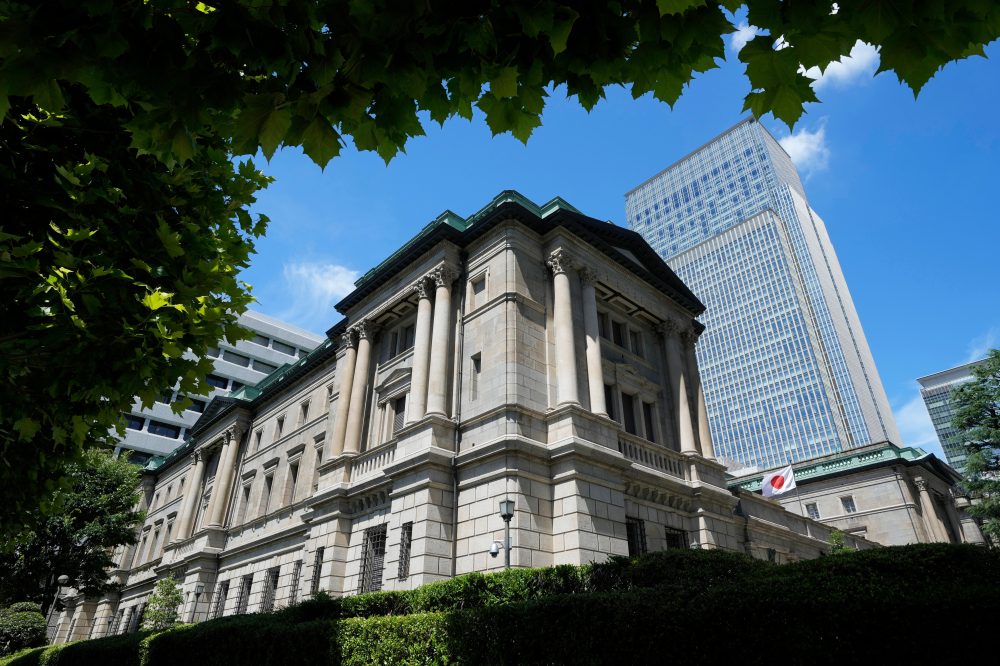
Global investors are bracing for a possible interest rate hike by the Bank of Japan on Friday, a move that would take the benchmark to a 30-year high, potentially rattling world markets.
The BOJ began its final policy meeting of the year Thursday. It’s expected to wrap up that meeting by raising its key policy rate by 0.25 percentage points to 0.75%, the highest level since September 1995.
That’s still low by most standards, but the BOJ kept that rate near or below zero for years, trying to pull the economy out of a deflationary funk. Since the pandemic, most other central banks, like the U.S. Federal Reserve, have raised rates to counter spiking inflation and then begun cutting them to help their slowing economies recover momentum.
Japan’s own economy contracted at a 2.3% annual rate in the last quarter, but improved business sentiment and price pressures have led the BOJ to relent and raise rates. Here are some things to know about its decision.
Since Japan’s economic bubble burst in the early 1990s, the central bank has kept borrowing costs low to encourage more spending by businesses and consumers.
Lower interest rates have also helped the central bank manage the country’s massive national debt, which amounts to nearly triple the size of the economy.
As Japan’s population has aged and begun declining, its economy has slowed and that led to deflation, or falling prices due to weak demand. Even with cheap credit, investment has lagged, stunting economic growth.
In early 2013, the central bank launched what was dubbed a “big bazooka” of monetary easing, cutting interest rates and purchasing government bonds and other securities to help channel more money into the economy. When the COVID-19 pandemic struck, the interest rate was at minus 0.1%. The BOJ only began raising it in 2024, the first hike in 17 years, after inflation stabilized above its target of about 2%.
The Japanese yen has weakened against the U.S. dollar and many other major currencies. That has raised the cost, in yen terms, of imported food, fuel and other items needed to keep the world’s fourth largest economy running.
The strong appetite for investing in dollar-denominated shares of companies linked to the artificial intelligence boom has also pulled money out of the yen and into dollars.
So inflation has risen faster than wages, squeezing household budgets and raising costs for businesses.
Higher interest rates are expected to raise the value of the yen against the dollar as investments flow into Japan seeking higher yen-denominated yields. Friday’s move would signal the central bank’s intention of continuing to “normalize” its monetary policy with further rate hikes next year.
“The BOJ’s stance towards rate hikes reflects the fact that inflation is becoming entrenched,” Kei Fujimoto, a senior economist at SuMi Trust, said in a commentary. “If drivers such as a further depreciation of the yen accelerate inflation going forward, it is possible that the pace of rate hikes will also increase accordingly.”
The dollar is worth about 156 Japanese yen, nearly twice its level in 2012 and near its highest level this year.
Even small changes in interest rates can have a big impact on markets. A rate hike in Japan would undermine an investment strategy known as the “carry trade.” That involves investors borrowing cheaply in yen and then using that money to invest in higher paying assets elsewhere.
Any such major shift is likely to reverberate across world markets. Carry trades are lucrative when stocks and other investments are climbing, but losses can snowball when many traders face pressure to sell stocks or other assets all at once.
A rate hike also is expected to crimp demand for other assets, including cryptocurrencies. Reports last week that the BOJ would go ahead and raise rates caused the price of bitcoin, for example, to drop below $86,000. The original cryptocurrency had bolted to record highs near $125,000 in early October.
Judging the timing and scale of changes to interest rates and other monetary policies are the biggest challenge for central banks, given the time it takes for such moves to ripple throughout the real economy and financial markets.
Like the Federal Reserve, Japan’s central bank struggles to balance the need to boost business activity and create jobs with the imperative of containing inflation.
The BOJ held off on raising rates earlier given uncertainties over how U.S. President Donald Trump’s tariffs might hit automakers and other exporters. A deal setting U.S. duties on imports from Japan at 15%, down from the earlier plan for a 25% rate, has helped ease those concerns.
BOJ Gov. Kazuo Ueda has indicated he believes wages will continue to rise in Japan as companies compete for a shrinking pool of workers, helping to support growth.
Market watchers will be watching closely to see what Ueda says Friday about the outlook for future rate increases.
Brought to you by www.srnnews.com