





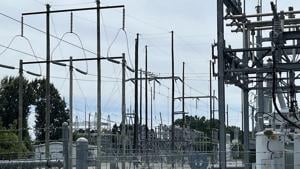
(RealClearWire) – The largest structure proposed in Pennsylvania’s 7th congressional district is a building that will, once completed, contain almost no workers. Across the road from Parkland High School in South Whitehall Township, a developer has drawn up plans for the Atlas data center campus, roughly 5.1 million square feet spanning six buildings, to be supported by its own electric substation. PPL Electric, the utility that serves the Lehigh Valley, says its load could triple over the next 5 to 7 years, and that without new generation the region could see brownouts. The students looking out at that substation will have to pay for the power it draws long after graduation.
Harvard-educated Ryan Mackenzie flipped this district to Republicans in 2024 by about 4,000 votes. In the May primary, Democrats nominated Bob Brooks, a 20-year Bethlehem firefighter who runs the state firefighters union, to take it back, and both men are campaigning on the same word, affordability, which in the Lehigh Valley relates directly to the electric bill. PPL’s price to compare has climbed 66% since 2020. On June 1, it rose again, to 13.147 cents a kilowatt-hour, and energy analysts expect a typical summer bill to clear $200 (and for many home owners with large families and air conditioning it will surely be higher). Bloomberg has named the district a proving ground for whether the power bill can swing an election. Both men promise to bring costs down, though the price is set in a wholesale market that no member of Congress controls.
The market maker in question is PJM Interconnection, the grid operator for Pennsylvania and 12 other states, which pays generators to guarantee they can deliver power on the hottest and coldest days. The auction that cleared in 2023 set that capacity charge at $28.92 per megawatt-day. The next one came in at $269.92, an 860% jump. The December 2025 auction hit its administrative ceiling of $333 and still failed to lock up enough supply to rule out blackouts. PJM’s own market monitor attributes about 40% of that record $16.4 billion to data center demand. The next auction, scheduled for July, will not carry the price cap that Gov. Josh Shapiro negotiated last time, and most observers expect the uncapped number to run higher. PPL traces part of the climb to supply that started tightening before the data centers arrived, as older plants that could be switched on at will were retired with nothing lined up to replace them.
For six years, Pennsylvania was involved, via Tom Wolf’s executive order, in the Regional Greenhouse Gas Initiative, a cap-and-trade charge on power-plant carbon, and the threat by itself was enough. Reporting on that repeal for RealClear Investigations, I found that the years of litigation froze roughly $13 billion in proposed power plants, by the Marcellus Shale Coalition’s count, and cost a Pittsburgh boilermakers’ local about 30% of its members as the work crossed into Ohio and West Virginia. PJM dispatches the cheapest generators first, and a plant paying Pennsylvania’s carbon charge would lose those bids to one across the border paying nothing. “I cannot think of a new baseload power generation facility in Pennsylvania post-2019,” Marcellus Shale Coalition official Patrick Henderson told me. “You could point directly to RGGI for that.” Shapiro and the Legislature finally killed the regulation in last November’s budget, and the state Supreme Court dismissed the appeal in January.
Shapiro still wants some kind of Pennsylvania carbon pricing, now packaged as his Lightning Plan, whose PACER and PRESS bills would cap emissions and require a rising share of power from wind, solar and storage. The Commonwealth Foundation puts the 10-year cost at $157 billion and projects it would roughly double residential bills. The Natural Resources Defense Council, modeling the same plan, says it would save the average household money by 2042 and keep the state’s nuclear fleet from closing early. Both figures, it bears noting, come from groups with a horse in the race.
Mackenzie has signed on to the Energy Choice Act, which would bar states and towns from blocking a power source because of the fuel it burns, and he has framed his reelection around what he calls a positive vision on affordability. The logic, to be sure, is supply-side and old-fashioned. A grid short on capacity will charge a premium for it, so his fix is more gas, longer lives for the reactors already running, and a permitting process that stops parking new plants in a queue.
To his credit, union-man Brooks wants to crack down on price-gouging utility monopolies, and his platform calls nuclear power clean, safe and underutilized, pledging to approve new nuclear and gas plants while renewables get built. Those are not the positions of an energy radical, though Bernie Sanders endorsed him and the Working Families Party did, too. Brooks also wants to curb the warehouse sprawl eating the Valley, Here, his chief ally is Shapiro, the governor who killed RGGI and courts the data centers behind the capacity crunch, yet still pushes a carbon plan that will send household costs skyrocketing. That mix leaves a Lehigh Valley Democrat in the somewhat schizophrenic position of having to criticize the data centers while defending the union jobs that come from building the plants to power them – buildouts made costlier by the other policies being backed.
Neither Mackenzie nor Brooks will be able to vote down a PJM auction or conjure a power plant onto the grid. However, they can try to influence the order of operations regarding the burden on consumers, and Mackenzie is the better choice for energy affordability in the race. Build the plants, get the power cheap and plentiful enough to draw industry and put the trades back to work pouring the foundations, and leave the harder job of scrubbing out the carbon to a grid that first has enough power to go around. Pennsylvania already spent six years running it the other way, pricing the carbon first, and bills went up while plants got built across state lines. The substation opposite Parkland High School is going up either way. The students watching it rise have no choice but to inherit the troubled grid their elders have been fighting over, and the best version of that grid is the one somebody actually builds.