





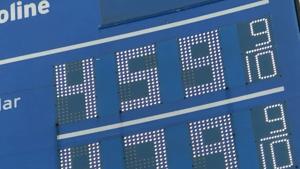
(The Center Square) – President Donald Trump on Wednesday ordered the U.S. Department of Justice to launch an immediate investigation into oil companies, accusing them of corporate “gouging” as retail gasoline prices lag behind plunging crude costs.
The president’s instruction, issued via social media shortly after midnight, orders federal investigators to determine whether oil companies are intentionally restricting fuel production or delaying downward retail adjustments to protect profit margins.
“The big Oil Companies are not dropping their price at the pump commensurate with the sharply lower prices they are paying for Oil,” Trump posted on Truth Social, noting that crude oil trading values have dropped “like a rock.” The president warned the nation’s largest oil companies, “Gasoline prices better start going down a lot faster than what I’m seeing!”
On April 7, wholesale West Texas Intermediate (WTI) crude futures reached a four-year high of $114.58 a barrel, but prices have declined steadily since the U.S. and Iran reached a 14-point interim peace agreement on June 16. The diplomatic breakthrough established a 60-day ceasefire and began reopening the blockaded Strait of Hormuz for ships carrying crude oil and other fuels.
While WTI crude values fell over 36% from that spring peak to trade midday Wednesday at $70.21, the national retail average for gasoline has eased by a much smaller 13%, dropping from $4.56 a gallon to $3.93.
Patrick DeHaan, head of petroleum analysis at GasBuddy, told The Center Square last week that lower gasoline prices are tied to continuing negotiations between the United States and Iran. “The decline came as oil prices moved sharply lower in reaction to news of a potential deal between the United States and Iran, though it remains to be seen whether the agreement will hold,” said DeHaan.
The speed of market price adjustments varies from state to state. In Minnesota, the state’s average price for regular unleaded stood at $3.69 per gallon on Wednesday, according to AAA Fuel Prices, down from $3.82 a week ago and 15% from $4.33 a month ago.
Louisiana motorists saw a smaller monthly decline, with the statewide average Wednesday hitting $3.51 a gallon-down 12 cents from the week prior and by 52 cents, or 13%, from $4.03 a month ago.
In coastal California and New York, where refiners rely heavily on waterborne shipments of crude oil, gasoline prices remain historically high. While emergency federal Jones Act shipping waivers were extended through mid-August to allow foreign-flagged tankers to move domestic petroleum products, price relief has been limited.
Since the peace agreement was reached nine days ago, California’s average price dipped to $5.53 per gallon and New York’s fell to $4.19, representing modest declines of 3% and 4%, respectively.
Recent polling data reveals a complex relationship between consumer anxiety and how voters are likely to assign political blame ahead of November’s midterm elections. According to The Center Square Voters’ Voice Poll, a nonpartisan survey conducted June 1-4 by Noble Predictive Insights, more than three-quarters of likely fall voters indicated that high fuel prices have significantly impacted household finances.
Additional data released Wednesday shows 49% of registered voters say wars or conflicts affecting global oil markets are most responsible for elevated fuel prices. Only 8% blamed federal policies, while 9% blamed oil and gas companies.
Mike Noble, founder of Noble Predictive Insights, said the 19% who believe all factors are equally responsible likely reflects an electorate that rejects overly simple political explanations.
“The ‘all equally responsible’ response may actually reflect a more nuanced view – or in some cases skepticism of overly simple political explanations,” Noble told The Center Square. “It suggests that while voters may lean toward blaming global conflict most, a meaningful share sees the issue as broader and more interconnected than that.”
The poll found that almost two-thirds of voters, 66%, say gas and fuel prices will likely influence their vote in November, with 37% indicating it is “very likely” to affect their ballot.