





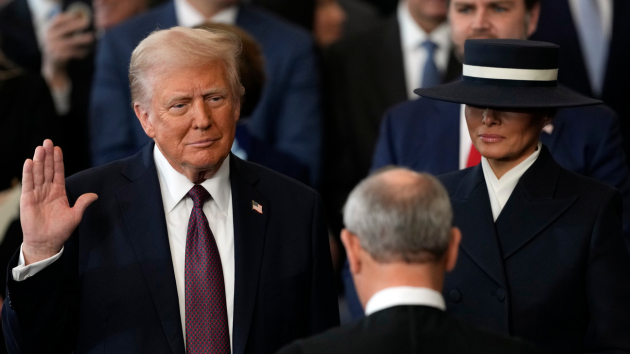
(WASHINGTON) — When President Donald Trump capped a historic political comeback on Inauguration Day last Jan. 20, he proclaimed the “Golden Age of America” had arrived, and in his first 12 months, the nation has experienced a whiplash of domestic and foreign policy changes, and political disputes that have stirred intense national debate.
Within hours of taking office, the president signed more than 200 executive actions, including rescinding nearly 80 actions under President Joe Biden, and pardoning 1,500 people convicted of crimes stemming from the Jan. 6 insurrection at the U.S. Capitol.
“From this day forward, our country will flourish and be respected again all over the world. We will be the envy of every nation, and we will not allow ourselves to be taken advantage of any longer. During every single day of the Trump administration, I will very simply put America First,” Trump vowed during his inaugural address.
A look at Trump’s first year shows a mixture of fulfilled promises, dramatic actions and ongoing controversies that show his political ambitions and the divided response from Americans.
Foreign policy
Trump ran on an agenda of “peace through strength,” promising to be a global peacemaker.
“My proudest legacy will be that of a peacemaker and unifier. That’s what I want to be, a peacemaker and a unifier,” Trump said during his address at the inauguration.
Since taking office, the president has made significant foreign policy decisions, from an on-the-ground operation to seize the leader of Venezuela, ratcheting tensions with Europe in an effort to seize Greenland and efforts to achieve peace in global conflicts from Ukraine to the Middle East.
The president achieved one of those goals by securing a ceasefire in the Israel-Hamas war that raged in Gaza. The delicate peace deal has held and recently moved into its second phase. The deal came after months of statecraft by Trump and many of his closest allies.
Trump has also formulated what he calls the “Donroe Doctrine,” a play on words of the Monroe Doctrine that reimagines the American role in the Western Hemisphere. That change in vision was punctuated by an on-the-ground operation in Venezuela to capture then-President Nicolas Maduro and bring him to the U.S. to face charges for allegedly supporting cartels that brought narcotics into the U.S.
That effort came after the administration carried out strikes on boats that were allegedly carrying drugs, killing more than 100 people. Those strikes have faced major questions from Democrats.
The president has also called for the U.S. to own Greenland and is ratcheting up tension with European allies as he tries to make good on his promised efforts to own Denmark’s semiautonomous territory. Those tensions have reached a fever pitch around Trump’s one-year mark in office as the president has not ruled out taking Greenland by force.
Trump vowed on the campaign trail to end the war in Ukraine on Day 1 of his term in office. However, after many meetings with Ukrainian President Volodymyr Zelenskyy and a historic summit on American soil with Russian President Vladimir Putin, that promise has failed to materialize. The war between Russia and Ukraine continues to rage on and Trump has repeatedly said that ending the conflict is more complex than he expected it would be.
Immigration
Trump has followed through on his campaign pledge to aggressively crack down on illegal immigration.
In 2025, the United States experienced negative net migration for the first time in at least 50 years as a result of the Trump administration’s immigration crackdown, according to a report by the Brookings Institution, which added that the number is mostly due to a significant drop in entries into the U.S.
The Department of Homeland Security claims more than 622,000 people have been deported since the president took office.
Throughout the year, the administration significantly expanded Immigration and Customs Enforcement (ICE) operations nationwide, with the White House publicly celebrating rising ICE arrests in multiple states, despite their controversial tactics, deadly force, legal pushback and protests.
A Quinnipiac University poll found 57% of voters disapproving of how ICE is enforcing immigration laws, with 40% approving, largely unchanged from Quinnipiac’s previous polling in July. Most Democrats and independents disapprove of how ICE is enforcing laws; most Republicans approve.
The president surged federal law enforcement and even troops into cities such as Los Angeles, New Orleans and currently Minneapolis, Minnesota, to help carry out immigration enforcement there. However, many local officials have spoken out against the enforcement operations.
Federal restructuring (DOGE)
Trump has also made major changes to the federal government, executing on another of his major changes to the size and powers of the federal government. Trump worked alongside billionaire Elon Musk for the first months of his presidency to enact the policy of the Department of Government Efficiency (DOGE).
DOGE took a chainsaw to much of the government, including shuttering the U.S. Agency for International Development (USAID) and firing or laying off thousands of federal workers.
In May, after months working to reshape the federal workforce and government, Musk said that the DOGE effort, which he promised on the campaign trail would cut $2 trillion in federal spending, saved about $160 million after about five months.
“I think we’ve been effective, not as effective as I’d like, I think we could be more effective, but we made progress,” Musk said in May.
Economic policies
Trump enacted one of his biggest campaign promises during his first year in office: widespread tariffs on goods brought into the U.S. The goal of the tariffs was to onshore manufacturing and slash trade deficits.
On April 2, which Trump dubbed “Liberation Day,” the president announced sweeping tariff policies on almost all of America’s trading partners and went far beyond what many experts expected his tariff policy to look like. Just one day later, the stock market tanked in reaction, with stocks losing nearly $3.1 trillion in value.
A few days later, the president paused those sweeping tariffs to give time for the administration to instead cut deals with nations. Trump said that investors had gotten “the yips,” which is why he pulled back. The administration set to work, promising to strike 90 deals in 90 days with America’s trading partners.
They fell short of that goal, but the White House has since reached deals or frameworks with dozens of America’s trading partners. The White House has also made significant carve-outs for some goods that cannot be produced or grown in the U.S. such as coffee and bananas.
The president came into office promising a “manufacturing boom” and that his policies would create “millions and millions of blue-collar jobs and jobs of every type,” but the final jobs report of 2025 showed hiring in the American economy is cooling.
Roughly 50,000 new jobs were added to the workforce in December, slightly below expectations, but the unemployment rate did drop to 4.4%. Roughly two thirds of overall job gains last year were in the health care sector, while manufacturing, tech and government all lost more jobs than they added, according to the Bureau of Labor Statistics.
The latest CPI report shows inflation up 2.7% from a year ago. Costs continue to rise for energy, medical care and foods such as coffee and ground beef, while wholesale egg prices have dropped to their lowest levels since 2019, according to the USDA.
The typical American household is now spending $184 more a month to purchase the same goods and services as a year ago, and $590 more a month than three years ago, according to Moody’s Analytics.
The president kicked off a tour in December to talk to Americans directly about his administration’s efforts to bring down costs. Trump has continued to insist that “affordability” is a “hoax” that was invented by Democrats.
Trump unveiled a health care plan, which he had promised for nearly a decade in early 2026. The administration unveiled his “great healthcare plan,” but the details are sparse, with top administration officials calling it “broad” and a “framework.”
Trump says he wants to give money directly to Americans so they can buy their own insurance, but it’s unclear how that would work, how much they will get or whether it would cover their health care costs. A recent poll found 52% of voters saying Trump has “hurt” the cost of health care.
The president has also planned to unveil a plan that would lower housing costs during an upcoming trip to Davos, Switzerland. It’s unclear what exactly the plan will entail, but the president has floated “steps to ban large institutional investors from buying more single-family homes” in an effort to improve housing costs.
Changes to the White House
Trump has also made his mark on the physical space of the White House. From ornamental changes to major tear downs, the president has made his mark on the historic home of the commander in chief.
What started with gilded additions to the Oval Office and the usual redecorating quickly became more long-lasting changes to the White House. The president repaved the historic Rose Garden with white stone and added what he dubbed the “Presidential Walk of Fame” which includes portraits and politically charged plaques about American presidents through history.
One of the biggest moves came in October of 2025, when Trump tore down the White House East Wing to make way for a 90,000 square foot ballroom. The major construction and rapid pace of the tear-down faced major criticism from many Democrats.
The president has made his mark on other D.C. landmarks too. The president’s hand-picked board of the Kennedy Performing Arts Center voted in mid-December to rename the structure the “Trump-Kennedy Center.”
The president has followed through of many of his campaign promises. Yet a recent Reuters-Ipsos poll finds that on every issue measured, Trump does not enjoy majority approval. With the midterm elections looming, it remains to be seen whether the president will have the political capital to push through his agenda throughout his historic second term.
Copyright © 2026, ABC Audio. All rights reserved.