





By Ross Kerber
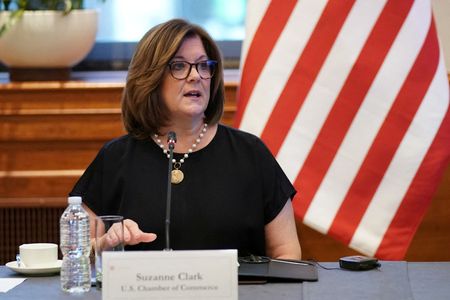
Jan 17 (Reuters) – Speaking before a darkened ballroom on Thursday, U.S. Chamber of Commerce CEO Suzanne Clark called on executives to be “fearless” in defense of free markets over government control and said the U.S. must remain “open to the world, open to the global exchange of talent and goods and ideas and innovation.”
The comments by the head of the most powerful U.S. business lobby group could be seen as mild pushback against President Donald Trump, who has waded into business mechanics like no other U.S. president. He has directed the U.S. to take stakes in tech companies, asserted control of corporate equity structures, imposed tariffs, and advanced immigration policies opposed by the Chamber.
This month, several CEOs, including Exxon Mobil’s Darren Woods and JPMorgan’s Jamie Dimon, also have offered temperate critiques of certain Trump agenda items. But they limited their remarks to sectors where they have interests – Venezuela’s oil and the U.S. Federal Reserve, while Clark did not mention Trump by name or his policies during the speech.
Several corporate governance experts said the statements and omissions were in line with a broader fear among business leaders that his administration will punish dissent. That is a marked difference from Trump’s first term, when executives split with him after his handling of a white nationalist rally in Charlottesville, Virginia, in 2017 and more openly spoke out against other policies.
Even as masked immigration agents confront U.S. citizens in Minneapolis and Trump considers seizing Greenland, which may cut off American businesses from European markets, the response from business leaders has been milquetoast, said Richard Painter, University of Minnesota law professor and chief ethics lawyer for former President George W. Bush.
Trump has adopted an authoritarian approach in contrast to Bush’s free-market economic policies, Painter said.
“I’d like to see a lot more aggressive stance from the Chamber here,” Painter said of Clark’s speech. “A lot of executives may have voted for Trump, but they need to speak out against coercion, whether it’s aimed at a protester in the streets or aimed at a CEO who isn’t doing what the president wants them to.”
Mark Levine, a Democrat who is the new New York City Comptroller overseeing public pension funds with stakes in the largest U.S. companies, said CEOs have taken only “baby steps,” speaking up only when Trump’s actions directly affect their businesses.
“I don’t think capitalism works if we allow a president with autocratic tendencies to dictate the behavior of every company in America,” Levine said.
TRUMP GETS LACKLUSTER RATINGS ON ECONOMY
Asked for comment, a Chamber spokesman noted a briefing that Clark held for reporters on Friday in which she said that “We are against government intervention in business, no matter which party is suggesting it.” She added that CEOs have been doing “quiet work” to promote sound public policies behind the scenes, and “not rushing to outrage.”
In August, Neil Bradley, the Chamber’s chief policy officer, told Reuters the group aimed to respond to Trump in a nonpartisan way, to preserve support for free markets.
Trump’s approval rating on the economy currently stands at a lackluster 36%, below his overall 41% rating even as he portrays his economic policies as succeeding by conventional measures.
“Under our administration, growth is exploding, productivity is soaring, investment is booming, incomes are rising, inflation is defeated, America is respected again like never before,” Trump said in Detroit on Tuesday.
A few prominent CEOs have openly questioned some of his actions.
On January 9, Exxon’s Woods told Trump that Venezuela is “uninvestable,” undercutting White House messaging about the industry’s future in the country. Woods added he was confident in Trump’s plans and that the company could soon dispatch a technical team to assess conditions there. Even so, two days later, Trump said he might keep Exxon out of future deals in the country.
“I didn’t like their response. They’re playing too cute,” Trump told reporters.
An Exxon representative declined to comment for this story.
On January 13, JPMorgan’s Dimon said he supported the independence of Federal Reserve Chair Jerome Powell, days after the administration opened a criminal investigation into Powell’s conduct. Dimon added that Trump’s meddling in the Fed could spike inflation. “I don’t care what he says,” Trump told Reuters about Dimon’s comments.
A JPMorgan representative declined to comment for this article.
A day earlier, Albert Bourla, CEO of Pfizer, said he was annoyed by Health Secretary Robert F Kennedy Jr’s move to roll back vaccine recommendations for children. “I’m seriously frustrated, because what is happening has zero scientific merit,” he told journalists in San Francisco.
Pfizer representatives did not respond to questions.
‘LOBBYING IS DIFFERENT NOW’
The Conference Board this week released a survey showing that for U.S. CEOs, the biggest risk factor in 2026 is uncertainty. Dana Peterson, chief economist at the Conference Board, said the survey did not specifically ask about Trump, but that “the executives I’ve spoken with understand that lobbying is different now.”
Gary Clyde Hufbauer, senior fellow of the Peterson Institute for International Economics, said CEOs may be calibrating their comments to avoid blowback and to position their companies to benefit from Trump’s policies or interests.
But unless companies push back, this could open the door to heavier regulation after Trump leaves office, Hufbauer said.
“My guess is they (CEOs) think the actions are a passing fad,” Hufbauer said. “Since state capitalism is catnip both to progressive Democrats and to some MAGA Republicans, executives and investors could be asleep at the switch,” he said.
(Reporting by Ross Kerber; additional reporting by David Gaffen, Mike Erman, David Lawder and Trevor Hunnicutt. Editing by David Gaffen and Deepa Babington)
Brought to you by www.srnnews.com