





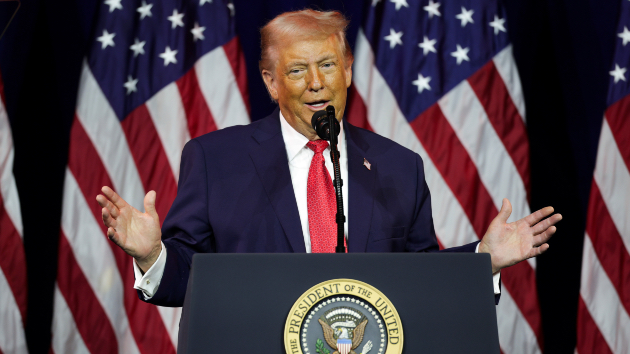
(WASHINGTON) — The White House will host America’s oil titans Friday as President Donald Trump is expected to lay out his plan for a post-Nicolas Maduro Venezuela with an economic revamp of its oil industry as its centerpiece.
The president, who said a recovery plan for Venezuela could require years of American involvement, told Fox News’ Sean Hannity Thursday that the U.S. would be “running the oil” and that he expected “at least $100 billion” of investment from the major companies.
“We’re going to rebuild the oil and the oil infrastructure, we’ll be in charge of it,” Trump said. “It’s going to do great, make a lot of money, and we’re going to take it from there, but we’re going to rebuild the country. And ultimately, you’re going to have elections.”
A White House official told ABC News that Secretary of State Marco Rubio, who has led the administration’s Venezuela policy, will attend the meeting that will include Chevron, Exxon, Conoco Phillips, Continental, Halliburton, HKN, Valero, Marathon, Shell, Trafigura, Vitol Americas, Repsol, Eni, Aspect Holdings, Tallgrass, Raisa Energy and Hilcorp.
A handful of those companies are European.
Only hours after American aircraft returned from an audacious mission in Caracas to arrest Maduro and take him to the U.S. for prosecution, Trump identified oil as the key to the U.S. strategy, asserting that American oil companies would quickly seize on a market newly friendly to them, generating revenues for America’s energy industry and establishing favorable ties with Venezuela. Trump and Rubio have said those revenues would ultimately benefit the people of Venezuelan people, some 82% of whom live in poverty, according to a 2024 report by the United Nations.
A risky choice for private industry
Experts told ABC News that the plan’s heavy reliance on the private American oil sector will present the industry with a risky choice to do business in a country some argue is less stable and harder to predict after the toppling of its president.
“The very first thing on oil all the oil companies checklist is going to be the outlook for political stability – durable political stability – that, by the way, needs to last a lot longer than the Trump administration,” said Clayton Seigle, a senior fellow at the Centers for Strategic and International Studies who focuses on energy security.
On Tuesday, the White House announced Venezuela would relinquish 30 to 50 million barrels of oil to the U.S., which would then sell the crude on the market and store revenues in American accounts.
Rubio on Wednesday fleshed out a three-phase strategy, including stabilization in Venezuela, economic recovery, and finally, a political transition there.
“They understand that the only way they can move oil and generate revenue and not have economic collapse is if they cooperate and work with the United States,” Rubio said. “And that’s what we are going to [see] happen.”
Rubio said the U.S. would continue enforcing a legal “quarantine” of illicit oil tankers transiting to and from Venezuela to bend Caracas to Washington’s will, citing the U.S. seizure of two such tankers this week. A third was seized Friday morning.
“We don’t want [Venezuela] descending into chaos,” he said, arguing the threat to the tankers would force the government, run by interim President Delcy Rodriguez, to the table.
Venezuela’s leadership, which has condemned the U.S. attack on its capital and the ouster of its president, has signaled a lukewarm embrace of cooperation on oil.
“Venezuela is open to energy relations where all parties benefit,” Rodriguez said.
Democrats called what the administration labels “leverage” as a form of brute control over the country.
“This is an insane plan,” said Sen. Chris Murphy, a Connecticut Democrat. “They are talking about stealing the Venezuelan oil at gunpoint for a period of time – undefined – as leverage to micromanage the country. I mean, the scope and insanity of that plan is absolutely stunning.”
‘Realist’ view of facts on the ground
Kimberly Breier, a former assistant secretary of State for Western Hemisphere Affairs during the first Trump administration, said the U.S. plan – which removed Maduro from power but kept the rest of his regime, including other U.S.-sanctioned officials, in place – was a “very realist” view of the facts on the ground.
“I think this is a transition to a transition,” Breier said. “I think this current situation is an intermediate step where there’s a hope and a plan that you’re going to be able to get the regime to do some of the harder things that are going to need to be done to allow for a real democratic transition to the rightfully elected government.”
Whether the energy dimension of the plan, which would require U.S. energy companies to work with the same regime that was hostile to them, is only “a hope and an aspiration” at this stage, said Seigle. “We don’t know how feasible it is.”
Oil executives who will sit down with the president in Washington will bring a checklist of questions on sanctions, tax regime, property rights, and political stability, experts told ABC News. Investments the White House might ask of them, which would include rebuilding and modernizing infrastructure, would require years and billions of dollars, they said.
“When it comes to energy, item number one is giving confidence in enduring political stability,” Seigle said.
The administration knows that oil companies “are looking for stability,” said Breier, who is now a senior adviser at Covington. “I think they’re looking for a leader that they think is not a transitional leader.”
“Certainly, oil companies operate all over the world in places that are not democracies. But from a policy standpoint…the durable, lasting leadership of Venezuela is the democratically elected one,” she said, referring to Edmundo Gonzalez, who won the 2024 Venezuelan presidential election but has been exiled.
Oil execs may not be ready to jump in
Oil companies will “express interest and to sincerely look into the matter and try to understand what their contributions could be and maybe some of the associated planning,” Seigle predicted. “But I do not think that we will see major new commitments from U.S. oil companies to leap into the Venezuelan operating environment until a lot of things on their checklists are satisfied.”
“The problem is [the administration] got the sequence backwards,” he said. “The sequence is the oil companies need to see that Venezuela is an attractive environment with a long runway of stability, and then in the future, the oil can flow.”
Breier said the energy dimension of the president’s plan is part and parcel of a broader set of objectives to counter migration and drug flows and promote a democracy in the country.
ABC News reported that the administration has made two demands to Rodriguez that must be met for the U.S. to allow the country to pump more oil. Venezuela must cut its economic ties with China, Russia, and Iran, sources said, and must agree to partner exclusively with the U.S. on oil production and favor America when selling heavy crude oil.
Breier said the reporting rings true with her experience at the State Department, where she worked with the former opposition leader of Venezuela, another elected president in exile, Juan Guaidó.
“With the Guaidó team, there were conversations about…not going [through] all this trouble for [Venezuela] to then cut deals with the Russians and the Chinese and the oil sector,” she said. “So that’s a very consistent approach.” Breier said the administration’s approach will be “private sector led” by Western companies, including the Europeans.
The White House “view[s] US companies as the most nimble and able to go in and start rebuilding the sector quickly so that you don’t end up with the U.S. taxpayer having to put the tab for reconstructing Venezuela,” she said.
Copyright © 2026, ABC Audio. All rights reserved.