







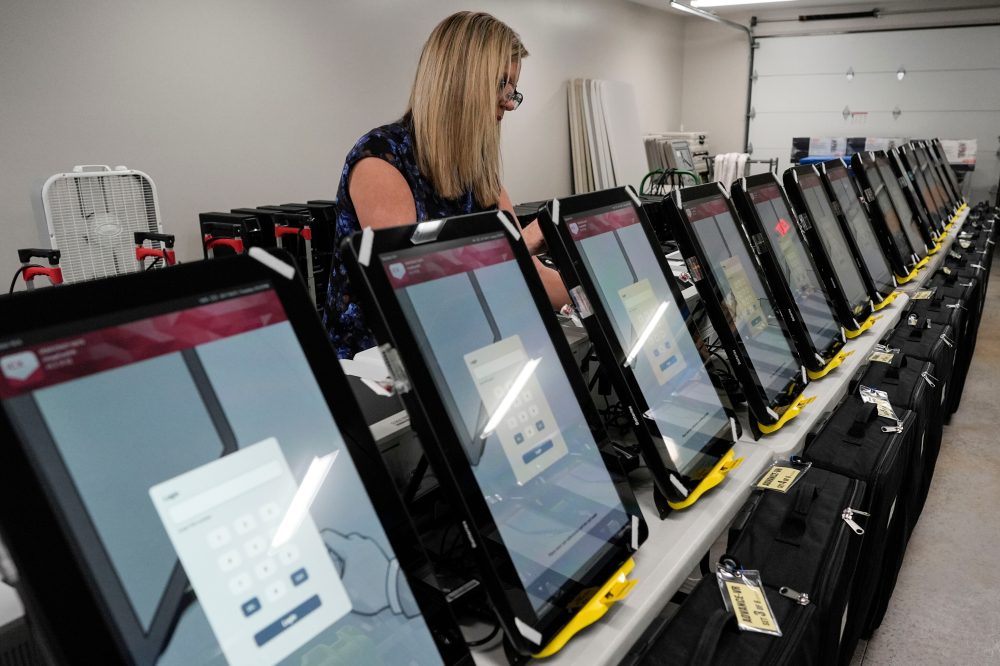
ATLANTA (AP) – Hand-marked paper ballots are Georgia’s backup when touchscreen voting machines can’t be used because of an “emergency,” and a proposed rule change would list the qualifying circumstances. Supporters say this would make it easier to determine if hand-marked ballots are needed, but critics say the change oversteps the State Election Board’s authority.
State law says if an “emergency situation” makes using touchscreen voting machines “impossible or impracticable,” voters may be given emergency paper ballots to be filled out by pen. The proposed rule, which is scheduled for a vote Wednesday, provides definitions of “impossible” and “impracticable” with qualifying circumstances.
Jeanne Dufort, a county Democratic official and an author of the bipartisan proposal, said the definitions provide a “critical guideline” to help officials decide when the touchscreen machines cannot be used.
Critics say the proposed rule runs afoul of a Georgia Supreme Court ruling earlier this year that said the State Election Board can pass rules to “implement and enforce” election laws, but cannot “go beyond, change or contradict” the laws. That ruling stemmed from a challenge to board’s adoption of a bunch of new rules before last year’s election.
Some opponents of the rule also worry it could be used to force a switch to hand-marked paper ballots in an end run around the state’s requirement that in-person voters use touchscreen voting machines.
“The rule cites state and federal provisions that are designed to protect ballot access and voter verification, but it really reinterprets them to justify halting the use of approved and certified equipment,” said Kristin Nabers, state director for All Voting is Local. “The statutes were never intended to give the power to invalidate voting systems.”
After expressing concern about the proposal, Sara Tindall Ghazal, the lone Democrat and only lawyer on the board, worked with its drafters on the language. But she abstained from the October vote to open the proposal for public comment ahead of this week’s vote.
“I think it goes beyond the scope of what the legislature intended to consider impossible or impracticable, which I see as unexpected circumstances that arise fairly suddenly and not the underlying conditions,” she said.
State Rep. Victor Anderson, vice chair of a special study committee on elections, said he believes the proposed rule goes too far and has asked the board to reconsider or redraft it. He said legislators are working to address concerns about the voting machines.
“I feel like the proposed rule is trying to get ahead of that before we handle it through the proper sources,” he said.
A longtime critic of the state’s voting machines, Dufort demurred when asked if someone could use the definitions to force a switch to hand-marked paper ballots. There is “nothing in these definitions that isn’t in Georgia law currently,” she said, adding that they just put everything in one place “in plain English.”
Georgia’s election system was implemented statewide ahead of the 2020 primary elections. Manufactured by Dominion Voting Systems, which was bought earlier this year by Liberty Vote, it includes touchscreen voting machines that print paper ballots featuring a human-readable list of voters’ selections and a QR code that a scanner reads to count votes.
Wild conspiracy theories about the machines proliferated after the 2020 election, when President Donald Trump’s allies alleged they were used to steal victory from him.
But even before that, some election integrity activists had argued voters can’t be sure their votes are accurately recorded because they can’t read the QR code and that the voting machines’ large, upright screens violate the right to ballot secrecy. They also asserted that the system has major security flaws that the state hasn’t addressed.
The secretary of state’s office maintains that the system is secure and Georgia’s election results are accurate and reliable.
The proposed rule defines “impossible” as meaning “voting equipment cannot be used at a polling place due to conditions beyond the reasonable control of election officials, or because its use would be unlawful under federal or state law.”
Along with things like power loss or mechanical failure, the list of qualifying circumstances includes “the failure of the voting equipment to allow each voter to read and verify, in a human-readable format, the official votes on the ballot he or she intends to cast” and “the failure of the system to be reasonably possible of being deployed in a polling place to protect the absolute secrecy of the ballot.”
“Impracticable” is defined as meaning voting on the machines “cannot reasonably be carried out without jeopardizing voters’ ability to cast a timely, secure, accurate, or secret ballot.” That includes the inability to arrange machines “to protect the absolute secrecy of the ballot.”
Both definitions include in their lists of circumstances a determination by the State Election Board, secretary of state or a court that the voting equipment “violates state or federal law” or is impossible or impracticable to use for an election.
Brought to you by www.srnnews.com