





(WASHINGTON) — Who is running Venezuela and how?
Confusion continued Monday amid seemingly contradictory messages from President Donald Trump and Secretary of State Marco Rubio about how the U.S. is dealing with the country after American forces captured dictator Nicolas Maduro over the weekend.
Trump on Sunday night doubled down on his assertion that the U.S. was “in charge” of the South American nation, after first proclaiming on Saturday the U.S. would “run the country until such time as we can do a safe, proper, and judicious transition.”
“We’re dealing with the people. We’re dealing with the people that just got sworn in. And don’t ask me who’s in charge, because I’ll give you an answer, and it’ll be very controversial,” Trump told reporters on Sunday as he flew back to Washington from Florida.
“What does that mean?” a reporter asked him.
“It means we’re in charge,” said Trump, who talked about extracting oil riches and potentially putting boots on the ground.
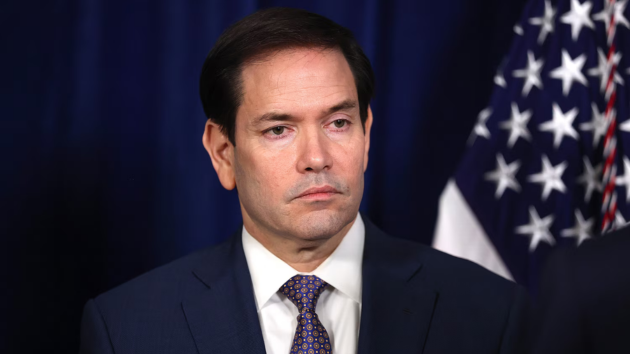
The president’s comments appear to be at odds with the less definitive characterization Secretary of State Marco Rubio made earlier Sunday during an interview on ABC’s “This Week.” Rubio is one of the Cabinet officials Trump said would “run” the country.
While Trump stated plainly that his administration was in charge and running things in Venezuela, Rubio was more circumspect, suggesting the U.S. would use economic leverage to impose its will.
“What we are running is the direction that this is going to move moving forward. And that is, we have leverage. This leverage we are using. And we intend to use. We started using already,” Rubio told ABC’s George Stephanopoulos, referring to the U.S. quarantine on sanctioned oil tankers.
Rubio, on NBC’s “Meet the Press” on Sunday, said the Trump administration control plan relates to policy changes.
“But it is running this policy. And the goal of the policy is to see changes in Venezuela that are beneficial to the United States first and foremost, because that’s who we work for, but also we believe beneficial for the people of Venezuela who have suffered tremendously. We want a better future for Venezuela,” Rubio said.
U.S. Ambassador to the United Nations Mike Waltz echoed Rubio on Monday, telling the United Nations Security Council that the U.S. is “not occupying a country.”
“As Secretary Rubio has said, there is no war against Venezuela or its people. We are not occupying a country. This was a law enforcement operation in furtherance of lawful indictments that have existed for decades. The United States arrested a narco-trafficker who is now going to stand trial in the United States in accordance with the rule of law for the crimes he’s committed against our people for 15 years,” Waltz said.
Waltz and other administration officials have described the capture of Maduro as a law enforcement operation that was facilitated by the U.S. military.
Maduro and his wife, Cilia Flores, were captured by U.S. forces early Saturday in the capital of Caracas.
Trump, speaking in-depth on the operation from his Mar-a-Lago club that morning, said the U.S. would “make Venezuela great again.” American companies would soon start selling the country’s vast oil reserves, he said.
But when pressed about who exactly would be running Venezuela, Trump said that it was some of the people “behind” him, which also included Defense Secretary Pete Hegseth.
On Saturday, a U.S. official gave more details about what the U.S.-run Venezuela would look like, saying that top administration officials would “continue to diplomatically engage with those remaining in the Venezuelan government” and also engage with oil executives as they begin to expand industry there.
Maduro and his wife made their initial appearance in Manhattan federal court on Monday to face federal charges, including narco-terrorism conspiracy and conspiracy to import cocaine. They pleaded not guilty. Maduro declared he is “innocent” and “still president.”
Meanwhile in Venezuela, the country’s vice president, Delcy Rodriguez, was sworn in as the interim president on Monday.
Trump on Saturday said Venezuelan opposition leader Maria Corina Machado, who won the 2025 Nobel Peace Prize, didn’t have the “respect” to govern the country.
He also had said that Rodriguez was cooperating with the U.S., a claim she appeared to dispute in an address to Venezuelans when she called for Maduro’s immediate release.
Asked on Sunday night to clarify where he stands with Rodriguez, Trump said: “I don’t have to tell you. I just say that she will face a situation probably worse than Maduro, because, you know, Maduro gave up immediately.”
In a more conciliatory message on Sunday night, Rodriguez said she would “prioritise moving towards balanced and respectful international relations between the United States and Venezuela, and between Venezuela and other countries in the region, premised on sovereign equality and non-interference.”
“President Donald Trump, our peoples and our region deserve peace and dialogue, not war. This has always been President Nicolas Maduro’s message, and it is the message of all of Venezuela right now. This is the Venezuela I believe in and have dedicated my life to,” Rodriguez wrote in a social media post.
ABC News’ Mike Pappano and Brianna Sanchez contributed to this report.
Copyright © 2026, ABC Audio. All rights reserved.