





By Andrew Chung
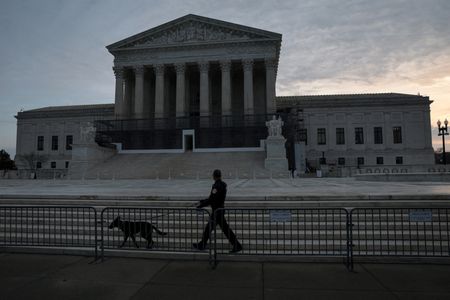
WASHINGTON, Jan 20 (Reuters) – California Republicans asked the U.S. Supreme Court on Tuesday to intervene in a bid to prevent the state from using a new congressional map designed to give the Democrats five more seats in the U.S. House of Representatives.
The state Republican Party and other challengers filed an emergency request asking the Supreme Court to block California’s new map, which was endorsed by voters as a counterweight to a similar redistricting effort in Texas aimed at boosting Republicans. A federal court on January 14 rejected the argument by the challengers that California illegally used race in redrawing the boundaries of the congressional districts.
The dispute represents another front in an ongoing nationwide battle over redistricting that was begun last summer by President Donald Trump’s request that Republican lawmakers redraw state congressional maps, starting with Texas, to help protect the party’s narrow U.S. House majority in the November 2026 midterm elections.
The Supreme Court, which has a 6-3 conservative majority, ruled in December to let Texas proceed with its new map.
Republicans currently hold slim majorities in both chambers of Congress. Ceding control of either the House or Senate to the Democrats in the November 2026 elections would endanger Trump’s legislative agenda and open the door to Democratic-led congressional investigations targeting the president.
The new Texas map could flip as many as five currently Democratic-held House seats to Republicans. Democratic-governed California reacted to the Texas redistricting move by initiating its own effort that could flip five Republican-held districts in the state to Democrats. California voters last November approved a ballot measure to allow lawmakers to adopt the new map.
The California Republican Party and other plaintiffs, joined by Trump’s administration, sued in Los Angeles federal court to block the new map, claiming it illegally used “race as a predominant factor” to favor Latino voters, in violation of the U.S. Constitution’s 14th Amendment guarantee of equal protection under the law, 15th Amendment prohibition on racial discrimination in voting and the federal Voting Rights Act.
That federal court on January 14 refused to block the map.
“Because we find that the evidence of any racial motivation driving redistricting is exceptionally weak, while the evidence of partisan motivations is overwhelming, challengers are not entitled to preliminary relief on any of their claims,” the court said in a 2-1 decision.
“Our conclusion probably seems obvious to anyone who followed the news in the summer and fall of 2025,” the ruling stated.
In their filing on Tuesday, the challengers to California’s map said that state officials sought to “shore up Latino support for the Democratic Party” through the “pernicious and unconstitutional use of race.”
Redrawing the boundaries of electoral districts in a state is a process called redistricting. States typically create new maps each decade to reflect new census data, though the recent rounds of redistricting have been motivated by securing partisan advantage, a practice also known as partisan gerrymandering.
The Supreme Court removed a key constraint against partisan gerrymandering, which critics have said warps democracy, in a major 2019 ruling that declared that such actions cannot be challenged in federal courts.
The Supreme Court’s decision to green-light the Texas redistricting effort, over the dissent of the court’s three liberal justices, appeared to acknowledge the political motivations of both that state and California.
Conservative Justice Samuel Alito additionally wrote in a concurring opinion that it was indisputable that the “impetus for the adoption of the Texas map (like the map subsequently adopted in California) was partisan advantage pure and simple.”
(Reporting by Andrew Chung; Editing by Will Dunham)
Brought to you by www.srnnews.com