





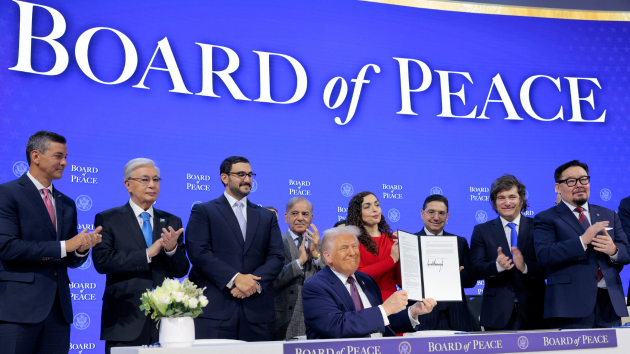
(NEW YORK) — President Donald Trump hosted a signing ceremony for his Board of Peace on the sidelines of the World Economic Forum in Davos on Thursday, saying that it was a “very exciting day” and that the collective would become one of the “most consequential bodies” ever created.
“As everyone can see today, the first steps toward a brighter day for the Middle East and a much safer future for the world are unfolding right before your very eyes,” Trump said in his opening remarks.
He added, “Together we are in a position to have an incredible chance — I don’t even call it a chance, I think it’s going to happen — to end decades of suffering, stop generations of hatred and bloodshed and forge a beautiful, ever-lasting and glorious peace for that region.”
More than two dozen countries have so far accepted Trump’s invitation to join the board, but none of the U.S.’s major European allies have yet made a commitment and some have rejected the idea. Trump was flanked on the stage in Davos by more than a dozen leaders whose countries had agreed to be signatories. He described those who were present as “just the countries that are here.”
U.S. special envoy Steve Witkoff said in an interview on CNBC on Wednesday that up to 25 countries had accepted the invitation to join the board.
Invitations were sent over the weekend to more than 50 world leaders, according to U.S. officials. A White House official said about 30 countries were expected to join.
The initiative has drawn cautious responses from several U.S. allies who did not explicitly endorse the board or accept Trump’s invitation as leaders question whether a U.N. alternative body is necessary.
“I think the board of peace will be the most prestigious board ever, and it’s going to get a lot of work done that the United Nations should have done,” Trump said Wednesday. “And we’ll work with the United Nations. But the Board of Peace is going to be special. We’re going to have peace.”
When asked by a reporter at the White House on Tuesday if the board would replace the U.N., Trump said: “It might.”
France, Norway, and Sweden, have declined or expressed significant reservations about the board, while others like Germany, the United Kingdom, and Italy have remained noncommittal.
Russia was also extended an invitation, the Kremlin confirmed this week, despite the country’s continued assault on Ukraine.
“The proposal made to us primarily concerns the settlement in the Middle East and the search for possible ways to resolve the pressing problems of the Palestinian people and the most acute problems of the humanitarian situation in the Gaza Strip,” Russian President Vladimir Putin told a Russian Security Council meeting, state media reported.
As of Thursday morning, more than 20 countries had said that they had accepted Trump’s invitation. Those countries were: Albania, Argentina, Armenia, Azerbaijan, Bahrain, Belarus, Bulgaria, Egypt, Hungary, Indonesia, Israel, Jordan, Kazakhstan, Kosovo, Kuwait, Mongolia, Morocco, Pakistan, Paraguay, Qatar, Saudi Arabia, Turkey, the United Arab Emirates, Uzbekistan and Vietnam.
“This is the greatest board ever assembled, and everybody wants to be on it,” Trump told reporters in Davos on Wednesday. “I have some controversial people on it, but these are people that get the job done. These are people that have tremendous influence.”
The full invitation list has not been made public by the White House.
Yvette Cooper, the U.K.’s foreign secretary, said during a BBC interview on Thursday that her country would not be among the signatories in Davos. Part of the reasoning behind that decision, she said, was the U.K.’s “concerns” about Putin being invited to be “part of something that’s talking about peace when we’ve still not seen any signs from Putin that there will be commitment to peace in Ukraine.”
During his remarks at the Board of Peace signing ceremony Thursday morning, Gaza ceasefire negotiator and real estate investor Jared Kushner unveiled some of the plans to redevelop war-torn Gaza.
Kushner said the plans for Gaza will emulate those of other newly redeveloped Middle Eastern cities, suggesting it will be completed in just two or three years.
“We’ve developed ways to redevelop Gaza. Gaza, as President Trump’s been saying, has amazing potential, and this is for the people of Gaza,” Kushner said.
“We think this could be done in two, three years. We’ve already started removing the rubble and doing some of the demolition,” he said.
But first, Kushner said, the next 100 days will be focused on sending humanitarian aid into the Gaza Strip, with quantities consistent with what was included in the Jan. 19, 2025, agreement, including rehabilitation of infrastructure (water, electricity, sewage); rehabilitation of hospitals and bakeries; and entry of necessary equipment to remove rubble and open roads.
The Board of Peace was first introduced last year with a two-year United Nations Security Council mandate to manage and rebuild Gaza, but the board’s charter makes no direct reference to Gaza at all.
A copy of the charter draft reviewed by ABC News makes clear the Board of Peace has a much broader mandate as an “international organization” and “peacebuilding body” seeking to resolve the world’s conflicts and securing enduring peace, akin to a U.S.-led alternative to the United Nations.
Trump, who is expected to chair the board, can potentially hold the position for life.
“The Chairmanship can be held by President Trump until he resigns it,” a U.S. official said. “A future U.S. president, however, may choose to appoint or designate the United States’ representative to the Board.”
The charter draft states that nations that accept the invitation will be given a three-year membership term, but permanent membership would be given to member states that contribute more than $1 billion in cash to the Board of Peace within the first year.
The U.S. official said that contributions to the board are “voluntary” and should not be considered as an entry fee to join. If member states choose to contribute money, the Board of Peace will “implement the highest financial controls and oversight mechanisms,” the official said.
Putin suggested Russia could pay its $1 billion from assets frozen by the U.S. over its war with Ukraine.
The executive committee that would oversee the board will include former British Prime Minister Tony Blair, Canadian Prime Minister Mark Carney and U.S. Secretary of State Marco Rubio, as well as Witkoff and Kushner.
ABC News’ Morgan Winsor contributed to this report.
Copyright © 2026, ABC Audio. All rights reserved.