





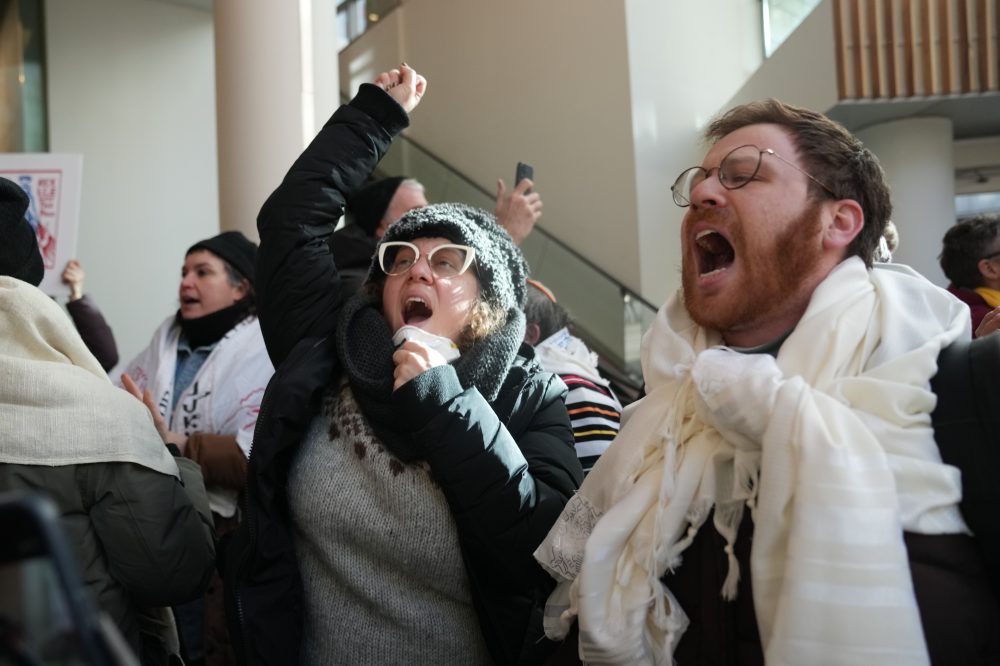
American religious history is rife with protest movements and civil disobedience. Yet it is rare for political protests to happen inside a house of worship.
That is part of what makes the new case against anti-ICE protesters in St. Paul, Minnesota, unusual. The group interrupted a service last Sunday at Cities Church, a Southern Baptist congregation, where one of its pastors works for U.S. Immigration and Customs Enforcement. Three of the protesters were arrested on federal charges Thursday.
Charles C. Haynes, a senior fellow for religious liberty at the Freedom Forum, a nonprofit group advocating for First Amendment rights, said disrupting a worship service is against the law – and that was likely the point.
Civil disobedience is by nature violating the law to bring attention to a cause. Famously, civil disobedience by the Rev. Martin Luther King Jr. and others led to landmark legislation during the Civil Rights Movement.
Before her arrest Thursday, civil rights attorney Nekima Levy Armstrong, who describes herself as a Christian, depicted the protest in religious terms on Facebook: “It’s time for judgment to begin and it will begin in the House of God!!!”
Haynes said, “Absolutely, in my view, civil rights law should be invoked when people interfere with the religious freedom of others in their house of worship.” At the same time, he noted that protesters typically feel their cause is too urgent not to take drastic action.
More common are protests outside houses of worship, such as recent anti-Israel demonstrations outside synagogues in New York City or a Kansas church’s picketing of military funerals. Courts and politicians have struggled to balance the rights of protesters and worshippers.
With such regulations “the devil (no religious pun intended) will be in the details,” legal scholars Vikram Amar and Alan Brownstein wrote in a recent analysis in the online journal Verdict of laws regarding protest-free buffer zones around houses of worship and other sensitive places.
Though unusual, worship disruptions have a long pedigree.
Radical Quakers in colonial America disrupted services of established churches they considered illegitimate.
The African Methodist Episcopal Church traces its 18th century origins to a walkout by Black worshippers from a white church where they experienced discrimination.
Civil rights activists staged “kneel-ins” at segregated churches in the 1960s.
One of the most dramatic actions in recent memory was the 1989 “Stop the Church” demonstration, organized by members of AIDS Coalition to Unleash Power (ACT UP).
The organization – which used civil disobedience to protest the government and the Catholic Church for what it saw as a weak response to the AIDS crisis – disrupted a Mass at St. Patrick’s Cathedral in New York with shouting, lying in the aisles and in one case desecrating a Communion wafer. They faced minor charges under state law, according to news accounts.
“There was a lot of pushback,” Haynes said. “But for ACT UP, it was life or death for them at the time.”
In 1984, protesters disrupted services at wealthy churches in Pittsburgh, citing the plight of workers idled by the collapse of the steel industry. The protesters – targeting churches with influential corporate executives and board members – drew diverse reactions, with some admiring their courage and others saying they did their cause more harm than good.
Some protesters tactically keep within the law while relying on provocative messaging and shock value.
The Kansas-based Westboro Baptist Church conducted controversial protests condemning America for tolerating homosexuality, even targeting the funerals of fallen troops. But protesters stayed outside of sanctuaries, and the U.S. Supreme Court upheld their right to protest, though states enacted laws limiting when and where funeral protests could take place.
“The First Amendment doesn’t protect us from disturbance if it’s a peaceful protest and it’s far enough away,” Haynes said.
Protesters against Israel’s actions in Gaza have recently targeted synagogues in New York City, leading to proposed legislation keeping protests 25 feet from the property line of houses of worship. Such buffer zones are common, as are some limits on free speech, including location.
While many religious groups have denounced the ICE surge in Minnesota, the protest inside Cities Church has received relatively little support. For example, the Minnesota Council of Churches, which joined in calls for a Friday boycott of shopping, school and work, declined to comment on the arrests of the in-church protesters.
About three dozen protesters entered the Cities Church in St. Paul during last Sunday’s service. Some walked right up to the pulpit. Others loudly chanted “ICE out” and “Renee Good,” referring to the woman who was fatally shot on Jan. 7 by an ICE officer in Minneapolis.
One of the church’s pastors, David Easterwood, works for ICE.
“No cause – political or otherwise – justifies the desecration of a sacred space or the intimidation and trauma inflicted on families gathered peacefully in the house of God,” said Kevin Ezell, president of the Southern Baptists’ North American Mission Board, in a statement.
Even among clergy who oppose current immigration enforcement tactics, there is discomfort with such protests.
Brian Kaylor, a Cooperative Baptist Fellowship-affiliated minister and leader of the Christian media organization Word&Way, has criticized the Trump administration’s treatment of immigrants. But he said he was “very torn” by the protest in a church.
“It would be very alarming if we come to see this become a widespread tactic across the political spectrum,” he said.
Bishop Mariann Budde, the Episcopal bishop of Washington, D.C., was rebuffed by President Donald Trump after she asked him to show mercy to immigrants and LGBTQ+ people at an inaugural prayer service last year. She traveled this week to protest ICE in Minnesota, where she served as a priest for 18 years. Her response to the arrests of the church protesters was measured.
“No one should fear for their safety or security in a house of worship – whether they are members of Cities Church or immigrants afraid to enter for fear of detention,” Budde said in a statement. “We must protect the sanctity of every sacred space and the safety of all who gather in prayer.”
Religious congregations have tightened security protocols in recent years as deadly attacks on houses of worship and safety concerns have intensified.
Many faith leaders were dismayed when the government announced last January that federal immigration agencies can make arrests in churches, schools and hospitals, ending the protection of people in sensitive spaces.
No immigration raids during church services have been reported. Some churches have posted notices saying no federal immigration officers are allowed inside; others have reported a drop in attendance, particularly during enforcement surges.
The penalties can be severe. Federal officials said the three protesters are charged under a law originally enacted after the Civil War to counter vigilante groups like the Ku Klux Klan, who had been targeting newly freed slaves. It has been revised since and applied to a wide range of violations of constitutional rights.
The law carries a penalty of up to 10 years in prison — or more if it involves injury, death or destruction of property.
___
Associated Press writer Giovanna Dell’Orto in Minneapolis contributed.
___
Associated Press religion coverage receives support through the AP’s collaboration with The Conversation US, with funding from Lilly Endowment Inc. The AP is solely responsible for this content.
Brought to you by www.srnnews.com