





By Pavel Polityuk
KYIV, Dec 27 (Reuters) – The Zaporizhzhia nuclear power plant, Europe’s largest, is one of the main sticking points in U.S. President Donald Trump’s peace plan to end the nearly four-year war between Russia and Ukraine.
The issue is one of 20 points laid out by Ukrainian President Volodymyr Zelenskiy in a framework peace proposal.
Here are some of the issues regarding the facility:
WHAT ROLE MAY THE U.S. PLAY?
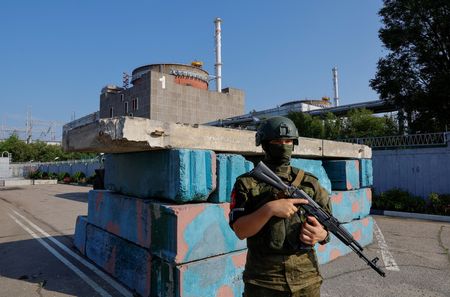
Russia took control of the plant in March 2022 and announced plans to connect it to its power grid. Almost all countries consider that it belongs to Ukraine but Russia says it is owned by Russia and a unit of Russia’s state-owned Rosatom nuclear corporation runs the plant.
Zelenskiy stated at the end of December that the U.S. side had proposed joint trilateral operation of the nuclear power plant with an American chief manager.
Zelenskiy said the Ukrainian proposal envisages Ukrainian-American use of the plant, with the U.S. itself determining how to use 50% of the energy produced.
Russia has considered joint Russian-U.S. use of the plant, according to the Kommersant newspaper.
WHAT IS ITS CURRENT STATUS?
The plant is located in Enerhodar on the banks of the Dnipro River and the Kakhovka Reservoir, 550 km (342 miles) southeast of the capital Kyiv.
The Zaporizhzhia nuclear power plant has six Soviet-designed reactors. They were all built in the 1980s, although the sixth only came online in the mid-1990s after the collapse of the Soviet Union. It has a total capacity of 5.7 gigawatts, according to an International Atomic Energy Agency (IAEA) database.
Four of the six reactors no longer use Russian nuclear fuel, having switched to fuel produced by then-U.S. nuclear equipment supplier Westinghouse.
After Russia took control of the station, it shut down five of its six reactors and the last reactor ceased to produce electricity in September 2022. Rosatom said in 2025 that it was ready to return the U.S. fuel to the United States.
According to the Russian management of the plant, all six reactors are in “cold shutdown.”
Both Russia and Ukraine have accused each other of striking the nuclear plant and of severing power lines to the plant.
The plant’s equipment is powered by electricity supplied from Ukraine. Over the past four years these supplies have been interrupted at least eleven times due to breaks in power lines, forcing the plant to switch to emergency diesel generators.
Emergency generators on site can supply electricity to keep the reactors cool if external power lines are cut.
IAEA Director General Rafael Grossi says that fighting a war around a nuclear plant has put nuclear safety and security in constant jeopardy.
WHY DOES RUSSIA WANT ZAPORIZHZHIA PLANT?
Russia has been preparing to restart the station but says that doing so will depend on the situation in the area. Rosatom chief Alexei Likhachev has not ruled out the supply of electricity produced there to parts of Ukraine.
Oleksandr Kharchenko, director of the Energy Research Centre in Kyiv, said Moscow intended to use the plant to cover a significant energy deficit in Russia’s south.
“That’s why they are fighting so hard for this station,” he said.
In December 2025, Russia’s Federal Service for Environmental, Technological and Nuclear Supervision issued a license for the operation of reactor No. 1, a key step towards restarting the reactor.
Ukraine’s energy ministry called the move illegal and irresponsible, risking a nuclear accident.
WHY DOES UKRAINE NEED THE PLANT?
Russia has been pummelling Ukraine’s energy infrastructure for months and some areas have had blackouts during winter.
In recent months, Russia has sharply increased both the scale and intensity of its attacks on Ukraine’s energy sector, plunging entire regions into darkness.
Analysts say Ukraine’s generation capacity deficit is about 4 gigawatts, or the equivalent of four Zaporizhzhia reactors.
Kharchenko says it would take Ukraine five to seven years to build the generating capacity to compensate for the loss of the Zaporizhzhia plant.
Kharchenko said that if Kyiv regained control of the plant, it would take at least two to three years to understand what condition it was in and another three years to restore the equipment and return it to full operations.
Both Ukrainian state nuclear operator Energoatom and Kharchenko said that Ukraine did not know the real condition of the nuclear power plant today.
WHAT ABOUT COOLING FUEL AT THE PLANT?
In the long term, there is the unresolved problem of the lack of water resources to cool the reactors after the vast Kakhovka hydro-electric dam was blown up in 2023, destroying the reservoir that supplied water to the plant.
Besides the reactors, there are also spent fuel pools at each reactor site used to cool down used nuclear fuel. Without water supply to the pools, the water evaporates and the temperatures increase, risking fire.
An emission of hydrogen from a spent fuel pool caused an explosion in Japan’s Fukushima nuclear disaster in 2011.
Energoatom said the level of the Zaporizhzhia power plant cooling pond had dropped by more than 15%, or 3 metres, since the destruction of the dam, and continued to fall.
Ukrainian officials previously said the available water reserves may be sufficient to operate one or, at most, two nuclear reactors.
(Additional reporting by Yuliia Dysa, Olena Harmash and Felix Hoske; Editing by Mike Collett-White)
Brought to you by www.srnnews.com