







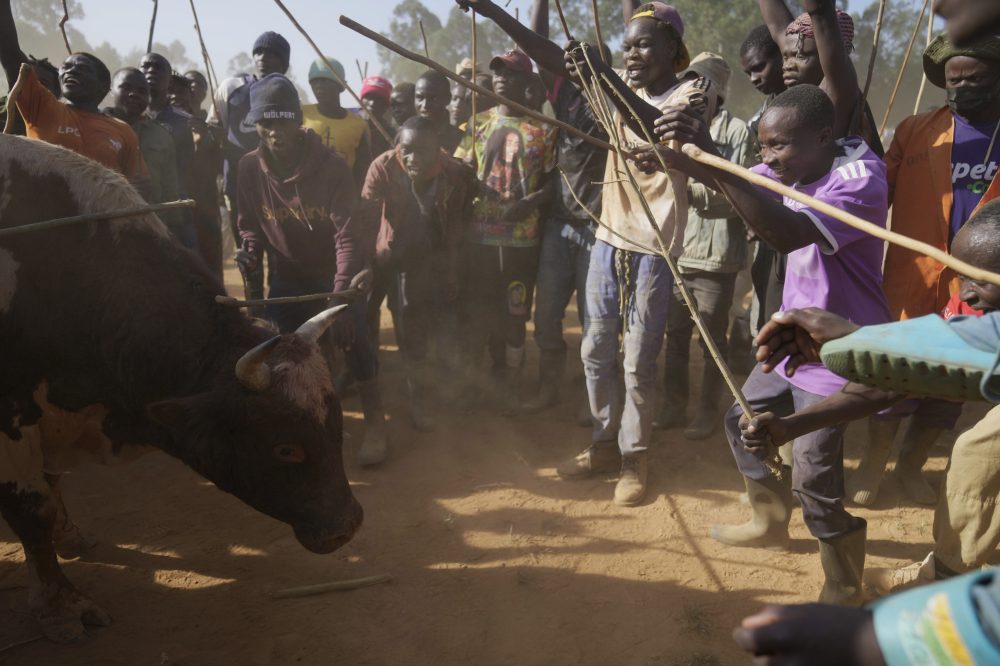
KAKAMEGA, Kenya (AP) – It’s match day in western Kenya’s Kakamega County, locally known as the home of bullfighting, where two bulls are brought to face off in a dusty arena as thousands cheer.
The derby is a rematch between a relative newcomer bull Shakahola, named after the forest where more than 400 people linked to a cult died in 2023, and another named Promise that has been a longtime favorite, only losing a few matches in over 10 years.
The bullfighting tradition is deeply rooted among the Luhya community in Kenya’s Kakamega County. It started as entertainment and celebrations after harvest season and has now evolved into a sport that attracts thousands of young people, some whom even place bets on social media platforms. During the matches, two bulls face off in under five minutes and after one escapes, the other is declared the winner. The bulls are not deliberately injured.
Sociologist Kathleen Anangwe, a lecturer at the University of Nairobi, attributed the growing interest in bullfighting to the need for socialization and the high rate of unemployment, which is about 9% according to official statistics. At least one workers’ rights group estimates unemployment is much higher for youth.
The sport is contributing to the economy, promoting unity and social solidarity, according to Anangwe. Through bullfighting, young people create an avenue to bond and use the matches to sell items such as snacks and bull chasing sticks.
“The youth are interested in identity, ‘who am I?’ and authenticity. Bullfighting gives them that opportunity,” Anangwe said.
Hours before the match, Shakahola the bull is given his daily dose of napier grass, water and a concoction of traditional herbs believed to make him stronger than his peers, according to the young man who has fed him for three years. He gets pampered inside a hidden shelter behind his owner’s house, away from prying eyes before being transported by truck to the fighting arena.
His owner Josphat Milimo talks to the bull as part of a traditional ritual, encouraging him to take on his opponent in under five minutes. Elders declare a Shakahola win while pounding the ground with their sticks covered in traditional herbs.
Today’s match is a rematch after Shakahola lost to Promise about two years ago. His owner believes this is his chance to get payback and win the match.
As the bull leaves the shelter to be loaded onto a waiting truck under the warm morning sun, hundreds of people aboard motorcycles escort it as they ululate and wave their chasing sticks that keep the bulls away – part of the spectacle that begins outside the arena even before the match kicks off.
At the fighting arena, some 10 kilometers (6 miles) away, thousands wait anxiously as Shakahola and Promise arrive with pomp, escorted by fans carrying flags bearing their photos. Vendors circulate the stands, selling sticks and refreshments. The bulls are cheered on by their respective stick-waving fans.
Shortly after, the circles open and the bulls face each other head-on. They lock horns and tear up the ground. Dust swirls around them, clouding the view for those closer to the action.
Brenda Milimo, 20, the niece of Shakahola’s owner, watches while cheering. She has become an TikTok sensation as a fan of bullfighting, and often travels from Nairobi to Kakamega via bus in a 4.5 hours journey just to attend major matches like this one.
“Bullfighting is in my blood,” she says.
In the past, she has placed bets of up to 1,500 Kenyan shillings ($11) despite being unemployed.
“We do casual betting via social media and through word-of-mouth, but I’m sure soon there will be a website for bullfighting betting because it’s becoming very popular among the youth,” she says.
For other spectators like David Gitau, who came from central Kenya, experiencing the bullfighting tradition is new.
“I’ve enjoyed myself and I’d like to encourage my kinsmen to come and experience this amazing tradition,” he says.
In about three minutes, the match is over as Promise runs out of the arena bearing blood marks on his hide.
It’s a win for Shakahola, and the crowd erupts into song and dance to the traditional drums while carrying his owner on their shoulders.
“I am very happy,” Josphat Milimo says. “Last time, I was cheated of victory and this time round I was ready.”
Brought to you by www.srnnews.com