





‘Israel Cannot Put All Its Eggs in One Basket:’ A Stable Alliance Faces Growing Scrutiny in America
Security coordination between Israel and Washington remains strong, but political polarization, generational change, and cultural framing inside the United States are increasingly shaping how the alliance is debated in public
By Gabriel Colodro / The Media Line
Israel’s relationship with the United States has long been treated as a strategic constant; military coordination, intelligence sharing, and diplomatic alignment have endured across wars, political crises, and leadership changes in both capitals. Yet beneath that continuity, a quieter change is unfolding, one that does not challenge cooperation itself but the public legitimacy that sustains it inside American society.
The paradox defining the current moment is difficult to ignore. Israel enjoys close access to the American administration while facing growing scrutiny among US voters, activists, and younger political actors. The alliance remains secure at the executive level but is now openly debated in the arenas that shape political consensus, where narratives, values, and identity carry growing weight.
It was against this backdrop that Israeli officials, researchers, and American experts convened to examine the state of Jerusalem-Washington relations, the pressure on shared values, and the evolving role of American Jewry. Hosted by the Institute for National Security Studies (INSS), the discussions focused less on reaffirming the alliance than on diagnosing its vulnerabilities at a time when its foundations are being tested.
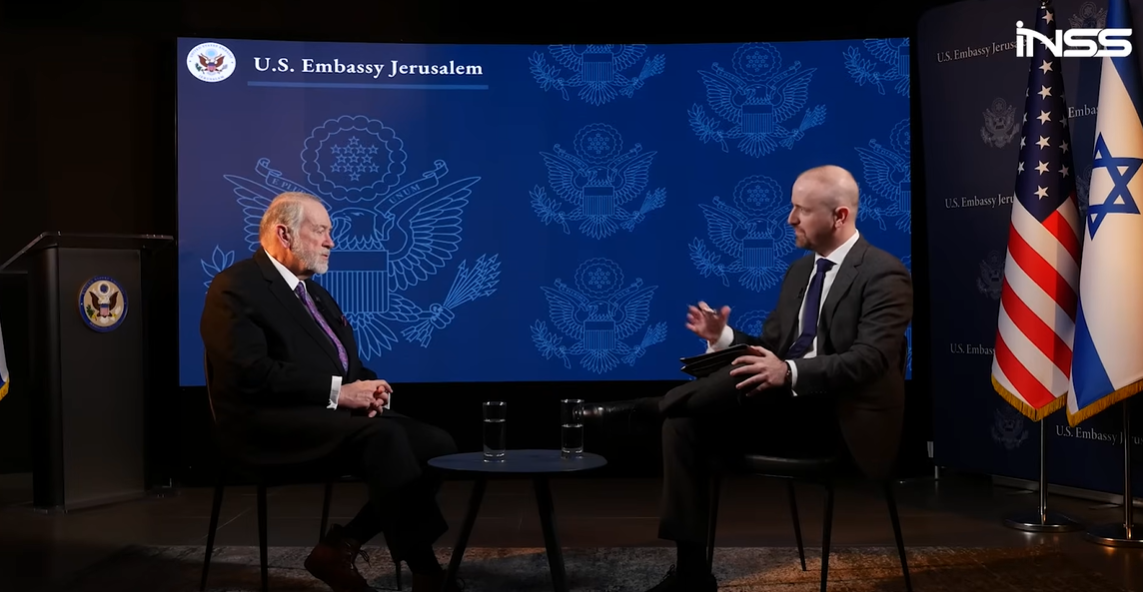
One of the clearest expressions of the transactional reality shaping the relationship came from a prerecorded interview with American Ambassador to Israel Mike Huckabee, presented during the conference. Addressing how American support for Israel is perceived domestically, the ambassador rejected the notion that the relationship is one-sided. He noted that many Americans believe the United States “does everything for Israel” before responding bluntly that this perception is exaggerated. The annual security assistance figure, he argued, sounds large in isolation but is modest in the context of the US federal budget, and its benefits flow back to the United States through defense procurement and battlefield innovation.
Huckabee framed military cooperation not as altruism but as mutual gain, pointing to Israel’s operational use of American systems as a source of battlefield data and technological insight that the United States itself rarely obtains. Yet the fact that such arguments must now be articulated so explicitly reflected a broader concern, echoed throughout the discussions: Support for Israel increasingly requires justification in economic and strategic terms that were once implicit.
The strategic implications of that shift were articulated most sharply by former Israeli Ambassador to the United States Michael Herzog, now a distinguished fellow at the Washington Institute for Near East Policy. Speaking with The Media Line, Herzog warned that Israel is approaching the American arena with an overly short-term lens. “Right now, Israel’s policy is focused on what happens tomorrow morning and the Trump administration,” he said, arguing that such an approach ignores deeper structural shifts.
Herzog stressed that the challenge is not confined to one political camp. “We have a problem in the United States on both the right and the left,” he said, adding that the erosion of support is most acute “especially among the younger generation.” Assuming that US backing will regenerate automatically with each electoral cycle, he warned, is no longer realistic. “Israel cannot and must not put all its eggs in one basket,” Herzog said, emphasizing the need to preserve bipartisan support over time.
That institutional framing was introduced by Lior Hayat, deputy director general for North America at Israel’s Ministry of Foreign Affairs, who emphasized that the relationship with Washington rests on converging interests, not assumptions of automatic alignment. “The US-Israel relationship is built on shared strategic interests and shared values,” Hayat said, but warned that neither can be taken for granted.
Hayat argued that Israel must adapt its diplomatic language to a changing American reality, particularly as domestic debates in the United States increasingly shape foreign policy positions. “We are not only talking to administrations,” he said. “We are talking to American society.” In that context, he stressed that maintaining bipartisan support requires constant engagement, not reactive messaging during crises.
The changing terrain of US politics was addressed directly by US politics expert and founder and director of LIBRAEL Rotem Oreg-Kalisky. He argued that Israel often underestimates how profoundly American discourse has shifted. “This is no longer a debate about specific Israeli policies,” he said. “It’s a debate about identity, power, and moral framing.”
According to Oreg-Kalisky, Israel’s image in the United States is now shaped less by traditional institutions and more by decentralized activist networks. “Social media ecosystems reward emotional narratives, not complexity,” he said, warning that official Israeli messaging struggles to compete in an environment where Israel is increasingly portrayed as a symbol rather than a state facing concrete security threats. “Israel today is not debated as a country,” he added. “It is debated as an idea.”
Concerns about ideological drift were not limited to the Democratic side. Senior research fellow at the Misgav Institute and director of the Churchill Program at the Argaman Institute Raphael BenLevi described what he sees as a broader collapse of trust in American institutions that is reshaping foreign policy debates across the spectrum. Speaking with The Media Line, BenLevi argued that skepticism toward elites and past decisions has left few assumptions untouched. “Almost all of the fundamental assumptions that used to be accepted by everyone are now on the dock,” he said.
That uncertainty, he added, is increasingly visible among younger conservatives who believe they were misled on issues ranging from the Iraq war to the COVID-19 pandemic. “There is a deep sense that they were lied to,” BenLevi said, arguing that this sentiment now shapes how foreign policy commitments are viewed. Support for Israel, once treated as axiomatic within the Republican Party, is increasingly filtered through the same distrust aimed at the foreign policy establishment. BenLevi warned that prominent right-wing voices, including Tucker Carlson, have contributed to narratives that frame Israel as part of a corrupt global elite. “When Israel is placed in that category,” he said, “it becomes an easy target.”
BenLevi advanced a particularly controversial argument when he suggested that the normalization of anti-Zionist rhetoric within segments of the Democratic Party has had spillover effects. “Once opposition to Israel becomes legitimate in one camp, it doesn’t stay there,” he said. In such an environment, he argued, Israel can no longer rely on ideological safe havens.
Few issues illustrate this shift more clearly than foreign aid. What was once treated as a strategic pillar is now increasingly scrutinized amid a broader backlash against overseas spending. BenLevi acknowledged that Israel can point to the tangible benefits of military cooperation but warned that perception often outweighs technical arguments. “Once something is labeled foreign aid,” he said, “it immediately becomes suspect, regardless of what it actually delivers.” As long as assistance is framed in those terms, he argued, it remains politically vulnerable even when its strategic value is clear.
The erosion of bipartisan comfort was also addressed by former US Ambassador to Israel Dan Shapiro, who served in Jerusalem during one of the most stable periods of bipartisan support for Israel and is now a distinguished fellow at the Atlantic Council. Shapiro argued that attitudes toward Israel within the Democratic Party have shifted sharply since Oct. 7. “What we saw after Oct. 7 was a moment of solidarity that was soon overwhelmed,” he said, pointing to the humanitarian toll of the Gaza war as a catalyst.
Shapiro linked that shift not only to the war itself but also to Israel’s domestic political image. He said that the prominence of far-right figures in Israel’s governing coalition has made it easier for critics to portray Israel as diverging from liberal democratic values. At the same time, he cautioned that Israel now faces skepticism “from both directions,” noting that emerging anti-Israel currents on the Republican side mean the old bipartisan shelter can no longer be taken for granted.
Beyond party politics, the discussions highlighted the strain on American Jewish communities navigating rising antisemitism alongside intensified debates over Israel’s identity. Director general in Israel and senior vice president for Israel and overseas at Jewish Federations of North America Rebecca Caspi described the response to Oct. 7 as unprecedented in scale, marked by rapid mobilization, massive fundraising, and the largest pro-Israel demonstration in American Jewish history.
At the same time, Caspi acknowledged a climate of fear that has taken hold across Jewish communities. “People are afraid,” she said. “They are afraid on campus, at work, and in public spaces.” Alongside that anxiety, she noted, many Jews report a renewed desire to engage more deeply with Jewish life, creating a community both energized and unsettled.
The moral dimension of Israel’s challenge was addressed directly by INSS researcher and author of Intifada on the Hudson, Ofir Dayan. Speaking with The Media Line, Dayan argued that Western political culture has undergone a fundamental inversion. “People in the US and in Europe do not want to support the side that is morally right,” she said. “They want to support the side that is weak.”
In her assessment, this shift has reshaped how the Israeli-Palestinian conflict is framed. “Israel is no longer David,” Dayan said. “Once the conflict is presented as Israeli-Palestinian rather than Israeli-Arab, Israel is necessarily the Goliath.” That framing, she argued, has little to do with facts on the ground and much to do with how power and vulnerability are interpreted in contemporary Western discourse.
Looking ahead, Dayan warned that generational change in the United States will deepen this trend. “Trump and Biden were the last two presidents who were fully supportive of Israel,” she said. “I don’t think we are going to see it anymore.”
Strategic alignment remains clearest in hard security arenas. Huckabee emphasized that US and Israeli objectives converge on Gaza, Iran, and regional stability, insisting that reconstruction in Gaza is impossible without the dismantling of Hamas and framing Iran’s nuclear ambitions as a direct American security threat. Yet even as these policy positions align, the broader concern remains unresolved.
What emerged from the discussions was not a warning of imminent rupture but of gradual erosion. The US-Israel alliance remains operationally strong, anchored in security coordination and shared interests, yet increasingly fragile in the political and cultural arenas that shape public consent.
As several speakers cautioned, alliances do not collapse when governments disagree. They weaken when societies stop caring. Military cooperation can survive leadership changes, but legitimacy cannot be renewed through memos, defense budgets, or joint statements alone.
The challenge Israel now faces in the United States is therefore not one of access but of time. Without a long-term strategy that speaks beyond administrations to voters, campuses, and emerging political actors, Israel risks preserving coordination while losing the argument that secures it.
Photo Credit: Gabriel Colodro/The Media Line
Brought to you by www.srnnews.com