





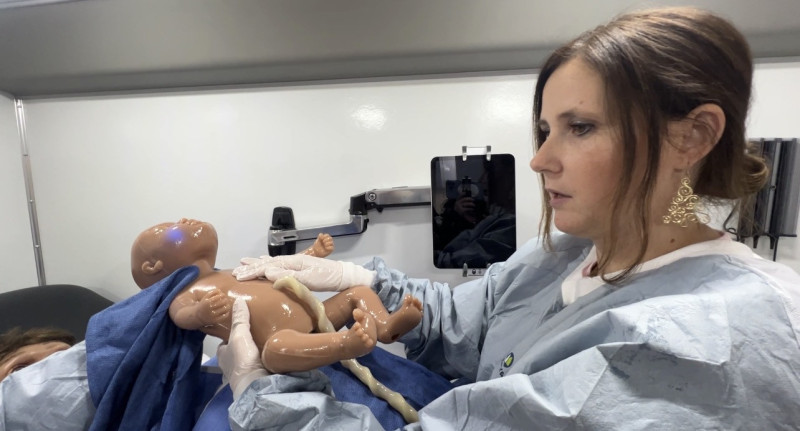
Health care providers with OSF HealthCare are stepping into high-stakes childbirth training inside a mobile pregnancy and postpartum care van. Staffed by advanced practice providers, the van visits maternity care deserts across Illinois—areas lacking access to obstetrics services. Hands-on drills with a high-tech manikin named “Victoria” are taking training to a new level, allowing teams to practice routine deliveries and emergencies like postpartum hemorrhage. Victoria mimics real patient responses by talking, breathing, and simulating complications, helping providers build confidence and sharpen decision-making skills. These regular simulations aim to improve safety and outcomes for mothers in underserved communities. To watch the simulations, visit here.
“What can happen, how do we manage this and be able to comprehend and evaluate and take care of this situation in real life. And sims training (with Victoria) has just been amazing for us,” Amy Mefford shares.
A mobile obstetric unit staffed by advanced practice providers is bringing vital care to twelve Illinois communities classified as maternity care deserts. In these counties, residents lack access to hospitals, birth centers, or local OB/GYN professionals. The team recently completed simulation training to prepare for potential emergencies and unexpected deliveries on the road. While giving birth inside the unit is considered rare, program leaders emphasize the importance of being prepared for any scenario. The initiative aims to bridge significant healthcare gaps, ensuring that expectant mothers in underserved areas receive necessary prenatal and emergency obstetric support close to home.
Medical teams are sharpening their skills against postpartum hemorrhage, one of the leading causes of maternal complications, through realistic simulation training. Using a high-tech manikin named Victoria, staff at OSF HealthCare’s Jump Trading Simulation & Education Center practice managing emergencies that can arise during childbirth, including severe bleeding. Victoria can simulate normal births, C-sections, and a range of complications, helping teams build confidence and master lifesaving protocols. The training focuses on readiness and teamwork, emphasizing swift action and coordination with EMS for real-life situations.
“I think doing the hemorrhage sims repetitively on a regular basis is extremely helpful for our team. It’s not something we hope we see on this van, but when we do, we want to feel confident, know the steps on managing hemorrhage,” Mefford stresses. “We have what we need on the van to manage those scenarios and to get the EMS team to us as soon as possible.”
“We can do normal vaginal deliveries. We can do C-sections. She has an ultrasound belly. She has a maternal hemorrhage feature. She even has a belly that can simulate a baby being the wrong direction and they can manipulate the baby to turn it around. She has a ton of features that have been a big help to us,” Jake Wilson shares.
Victoria is revolutionizing maternal care simulations. Victoria talks, breathes, and responds to questions, featuring interactive eye movements and fully programmable physiological responses in real time. Wireless and mobile, Victoria enables doctors and nurses to practice critical scenarios—from hemorrhage to C-section—not only in labs but inside mobile training units and across hospitals in the OSF Ministry. This technology allows teams to sharpen their skills in realistic, high-pressure situations. OSF leaders believe such advancements, combined with regular simulation exercises, will enhance maternal and fetal outcomes throughout the region.