





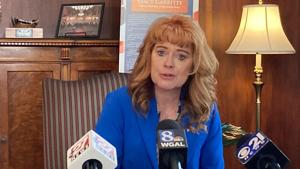
(The Center Square) – Pennsylvania’s energy future is emerging as a defining issue in the 2026 governor’s race, and both Democratic Gov. Josh Shapiro and Republican State Treasurer Stacy Garrity say their competing plans would make energy more affordable for residents.
Garrity, speaking recently before the Marcellus Shale Coalition in Hershey, promised a natural-gas-first agenda that would lift barriers to drilling, speed permits for pipelines and power plants, roll back energy mandates, and position the commonwealth as a national and global energy leader.
Her message offers a contrast with Shapiro’s broader energy approach, which also emphasizes affordability, reliability, and expedited energy project approvals, but places greater focus on clean energy investment and guardrails for large energy users.
Garrity criticized the current administration for instituting a cap on the price electricity can be sold at auction, calling it a “dangerous precedent.” PJM operates on a market-driven basis, she said, and the price cap does not fix the problem – it exacerbates it.
The industry welcomed the message, saying Pennsylvania has abundant gas but needs more infrastructure to move it to power plants, manufacturers, export markets and growing energy users such as data centers.
“Our industry prioritizes and values engagement with all policymakers, and we’re grateful that state Treasurer Stacy Garrity was able to join us in Hershey for our membership meeting,” said coalition President Jim Welty.
He told The Center Square that Garrity shared a strong vision for Pennsylvania’s future rooted in common-sense energy policies that embrace the state’s abundant natural gas resources.
“We appreciate her leadership and commitment to ensuring Pennsylvania remains a leader in energy production, job creation, environmental progress, and innovation,” he said.
Garrity described that vision as a 2030 Pennsylvania with 200,000 new family-sustaining jobs, lower electric bills, and 50,000 fewer regulations.
She said that on day one of a Garrity-Richey administration, she would sign an executive order lifting what she called “the outdated ban on new drilling sites.” She also said her administration would call a special session of the Legislature to fast-track permits for natural gas production, pipelines and power plants.
According to remarks provided to The Center Square by Garrity’s campaign, she told the coalition that current policies are forcing families to pay more each year, for heat, air conditioning and electricity.
“So rather than mandating the type of energy Pennsylvania uses, we will restore a competitive marketplace, replacing bad energy policies that are costing Pennsylvanians billions,” she said.
Pennsylvania ranks 38th economically, 39th in education, and 41st overall, Garrity said. She added that while the state trails near the bottom in those areas, it ranks in the top 10 in one troubling category: residents leaving. Her goal, she said, is to reverse that trend and make Pennsylvania one of the top 10 states where people are moving because of the opportunities available.
She said natural gas would drive jobs and revenue while defending the industry’s environmental record.
Garrity said about 120,000 Pennsylvania jobs are tied to natural gas, down from more than 300,000 a decade ago. She says her plan could create more than 200,000 jobs and generate $6 billion in state and local revenue, “allowing us to drill and frack our way out of the $5 billion hole we find ourselves in today.”
She said the Marcellus Shale basin – the largest natural gas field in the U.S. – is not the problem, but the solution. Garrity said producers have helped reduce CO2 emissions, operate with some of the lowest methane intensity levels among major shale basins globally, and have funded more than a half-billion dollars in environmental protection projects across the commonwealth.
Pennsylvania is the nation’s top net exporter of electricity, Garrity said, with natural gas accounting for nearly 60% of its power generation. She said she would press PJM and FERC to require other states to contribute their fair share of energy to the grid or face penalties for relying too heavily on power generated elsewhere.
Under her administration, she said, Pennsylvania consumers will no longer be forced to pay for what she called the failed policies of our neighboring states.
Garrity also proposed eliminating Pennsylvania’s Gross Receipts Tax on electricity, which she said would save the average family of four approximately $400 in the first year and eventually grow to $900 annually. She also said she would push for more transparency on utility bills and a standardized format to make it easier to compare rates.
Garrity said Pennsylvania is at a fork in the road and faces a choice about its future: whether families will continue bracing themselves for rising electric bills, or whether the state will use its own energy resources to build a stronger, more affordable future.